
Reading Borough Council's own emissions fell to 4,761 tonnes in 2025/26, 76% below 2008/09 but short of its 85% target. Emissions from Reading Buses rose 19%.
Reading Borough Council’s own carbon emissions fell to 4,761 tonnes in 2025/26, three quarters lower than in 2008/09. That was not enough to hit the 85% cut it set itself for 2025. The council missed the target by 1,797 tonnes.
The figures are in the council’s annual greenhouse gas report, which goes to the Strategic Environment, Planning and Transport Committee on Thursday 12 November (committee papers). The committee is asked only to note it.
The headline numbers
From the annual report on the council’s emissions:
- 4,761 tonnes of CO2 from the council’s own operations in 2025/26, down from 19,761 tonnes in 2008/09
- a 75.9% cut on 2008/09, against a target of 85% by 2025
- 9.5% lower than the year before, a drop of 499 tonnes
- £6.5 million of energy costs avoided in 2025/26, and about £41.9 million since 2008/09, compared with doing nothing
The target for the final year of the council’s Carbon Plan was 2,964 tonnes. The covering report gives the year’s total as 4,711 tonnes; the appendix and its tables say 4,761, and we have used the appendix.
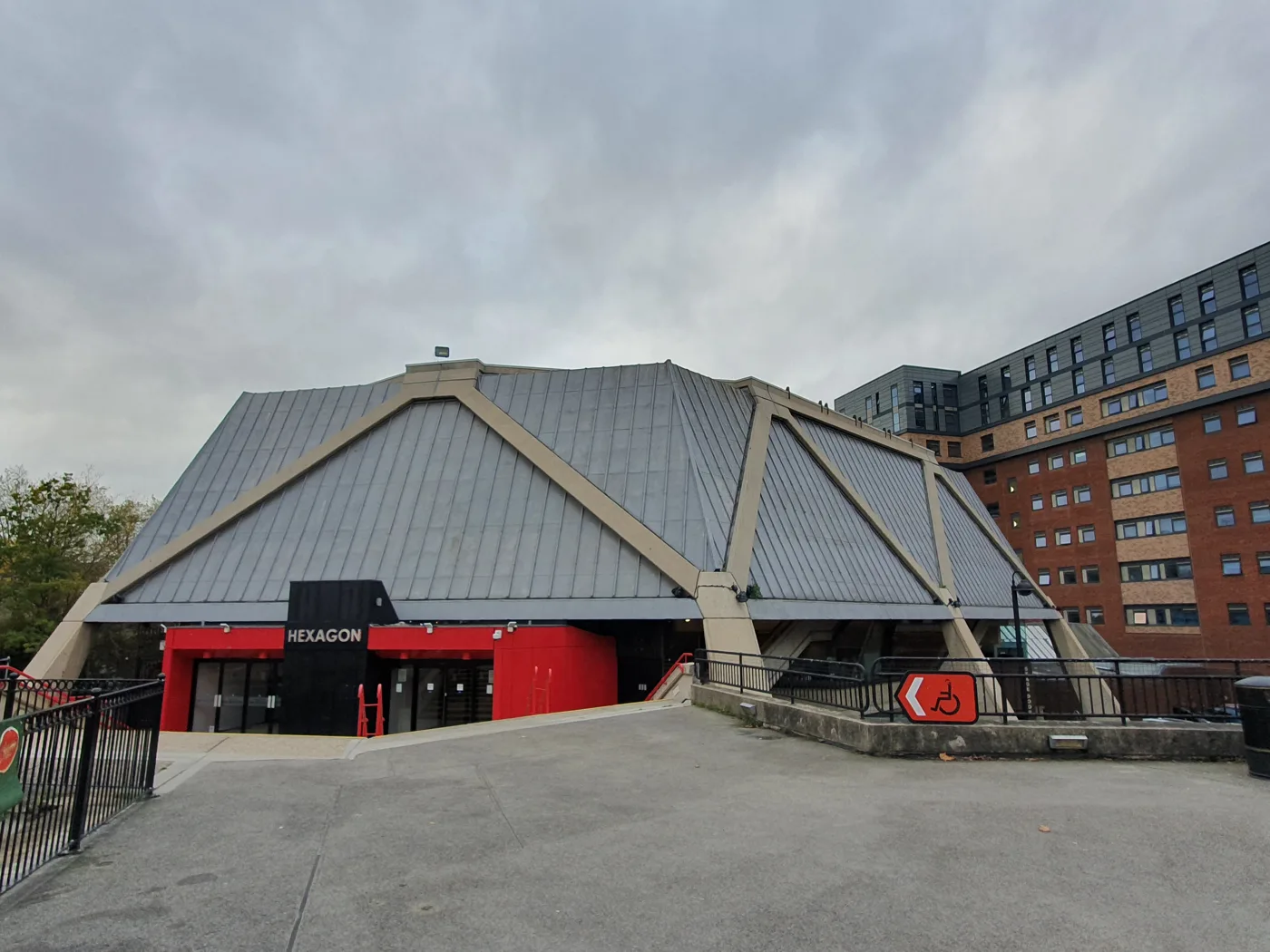
The covering report also admits that the council’s emissions “have plateaued over the last three reported years” (covering report). The council says the Civic Offices, now home to the Central Library, have heat pumps, chillers and solar panels. The Hexagon has been taken off gas and runs on heat pumps fed by boreholes. The report notes the Civic Offices savings are not yet in the figures.
The bus fleet is the biggest source
The council also counts a “wider influence” footprint. It covers schools, leisure centres, the Smallmead recycling plant and Reading Buses, which the council owns. That total was 22,784 tonnes in 2025/26, down 42% on 2008/09.
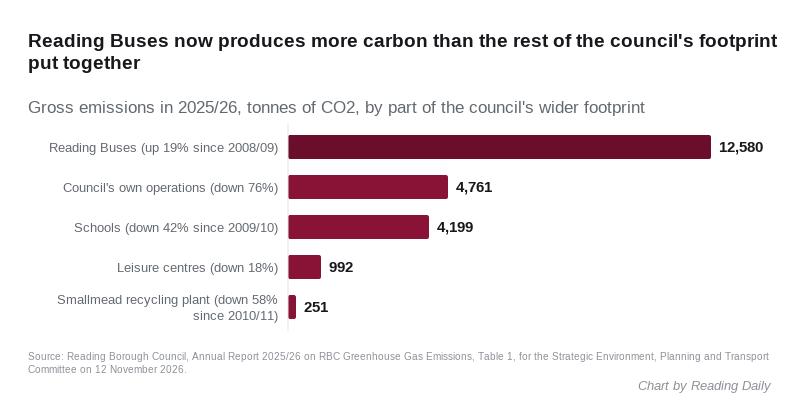
One part of it went the other way. Bus services produced 12,580 tonnes, up 19% on 2008/09. Last year alone they rose 5.1%, while the buses’ mileage rose 6.7%. The bus company now produces more carbon than every other part of the footprint combined.
The covering report says Reading Buses has put more than 30 electric buses on the road and is ordering another 20. The council’s press release puts the total funded at 49. Once all are running, the report estimates they will save about 3,750 tonnes of CO2 a year.
The rest of the wider footprint, from the same table:
- Schools: 4,199 tonnes, down 42% since 2009/10. The report says data from academies is less reliable, and that schools’ emissions have fallen only 14.7% in five years while pupil numbers rose.
- Leisure centres: 992 tonnes, down 18%. Rivermead’s emissions fell 22% last year once the new centre and its pools were fully open, and Palmer Park’s energy use fell 10%.
- Smallmead recycling plant: 251 tonnes, down 58% since 2010/11.
What else the report says
- Electric bin lorries: the council replaced all 13 refuse lorries with electric Dennis E-Collect vehicles. They “have suffered technical issues however and will require replacement”. The council will now focus on electric vans, and is buying the most efficient diesel models for larger vehicles in the meantime.
- Solar: the council has installed more than 10,000 panels on its buildings, homes and schools. Its own and community arrays generated 1,654,169 kWh last year. Renewables covered 9.8% of the energy its buildings used, against a target of 50% by 2025.
- A heat network: the council has applied to the government’s Green Heat Network Fund. The proposed network could run from Reading School to the Minster Quarter, passing the Royal Berkshire Hospital and the University’s London Road campus. A provisional site for its energy centre is the Queens Road car park on Kennet Side, using river source heat pumps.
- Waste heat from a data centre: the report says a data centre at Thames Valley Park could supply waste heat to such a network. We reported on that data centre application in October.
- Home grants: 299 households have applied for the Warm Homes Local Grant, and 41 homes had been retrofitted by August 2026 at a cost of £590,251.
The borough as a whole
The council’s own emissions are 1.2% of Reading’s total, according to Cllr John Ennis, the lead councillor for climate strategy and transport. Government figures show emissions across the borough fell 57% between 2005 and 2024. The report says that is the 15th largest cut of about 400 UK local authority areas. But the trend “has essentially plateaued”, and 2024 showed a 0.1% rise.
Cllr Ennis said the council would “continue to work with our partners and residents to accelerate the transition away from fossil fuels”. He added that “not everything is within the Council’s or borough’s control”.
A second Carbon Plan is being written. The first ended in April 2026.
What it means for you
- If you rent a council home: the report says most council homes are still heated by gas boilers. All rented homes must reach the equivalent of EPC C by 2030, and the council says it is still working out an affordable route and timescale.
- If you own your home: the council runs the Warm Homes Local Grant for households that meet its eligibility rules, and the Switch Together scheme, formerly Solar Together, for competitively priced green technology. In the current round 454 people registered interest, and about 8% are going ahead.
- If you have an electric car but no drive: the council’s contractor Char.gy had installed 153 kerbside charging points by the time of the report, out of more than 2,620 planned.
- If you want to follow it: the committee meets at 6.30pm on Thursday 12 November and is webcast. The same meeting decides on wider HMO rules for east Reading.
Have your say