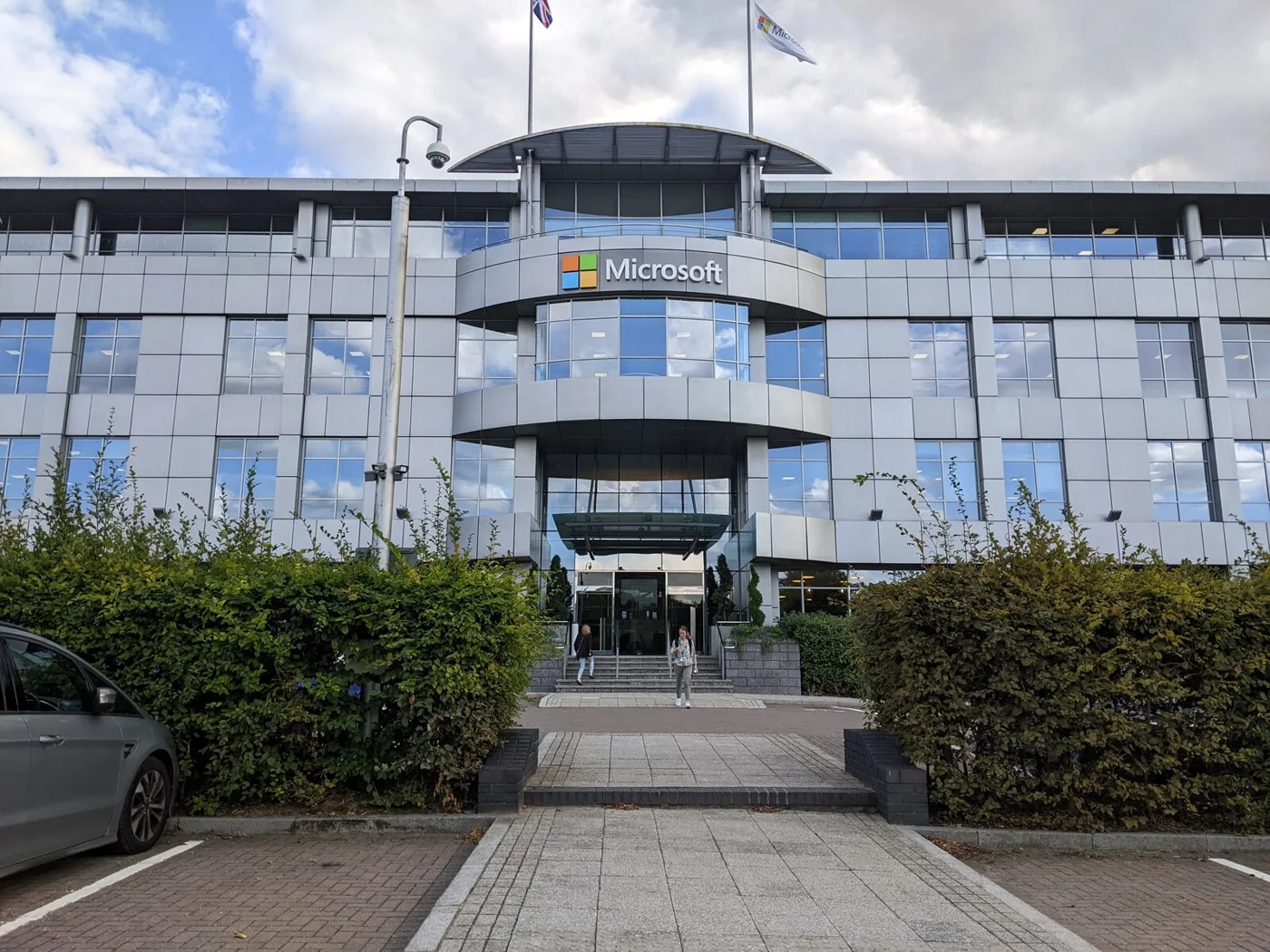

Microsoft's Thames Valley Park offices would make way for a 72MW data centre powered by gas fuel cells until 2037. Comments to Wokingham close 29 October.
Microsoft’s office campus at Thames Valley Park would be knocked down and replaced by a 72-megawatt data centre under an outline planning application now open for comment. For its first nine years the site would run mainly on gas.
The campus is on the eastern edge of Reading, about two miles east of the town centre. It sits in Wokingham borough, in Sonning parish, so Wokingham Borough Council decides the application, reference 262274. Public comments close on Thursday 29 October.
The applicant is FH Trustees, a company with a St Helier, Jersey address, acting as joint trustee of the Mapeley Beta HL Unit Trust. Its planning agent is the engineering firm Arup. Microsoft is not the applicant.
What the application proposes
The planning statement says Microsoft has already left two of its three buildings on the site. It holds a lease on the third until December 2027 and will leave when it ends. The three buildings hold 22,867 square metres of offices.
In their place, the application proposes:
- four three-storey data hall buildings, with an office building at the front
- up to 37,000 square metres of floorspace
- a maximum height of about 30.5 metres, which is the height of the back-up generator flues
- solid oxide fuel cells, back-up generators and a substation
- 72 car parking spaces and 36 cycle spaces
- round-the-clock operation, 24 hours a day
The application is in outline. Only the access is fixed now. The design would come later, within the limits this application sets.
The statement also says Microsoft is “currently under offer” for about 73,500 square feet in the Here building next door. That would be less than a third of the 246,200 square feet it used across the campus.
Power: gas fuel cells first, grid later
The site cannot get a big enough grid connection yet. The energy strategy sets out two phases:
- 2028 to 2037: fuel cells running on natural gas provide 42.5MW. The office building takes 1.8MW from the existing grid connection.
- From 2037: a grid connection of 60MW or 110MW arrives. The fuel cells could then stay on gas, switch to biomethane, or be removed.
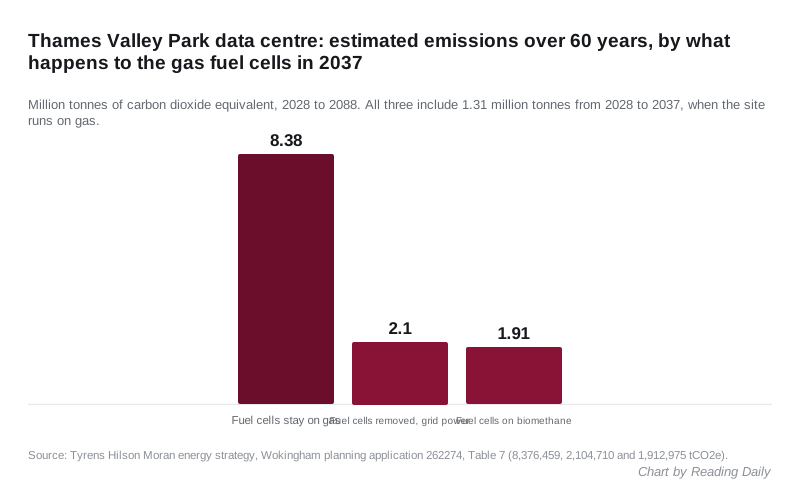
The applicant says removing the fuel cells and using grid power is its “preferred solution”. Its own figures show why that matters. Over a 60-year life, the energy strategy estimates:
- keeping the fuel cells on gas: 8,376,459 tonnes of carbon dioxide equivalent
- removing them in 2037: 2,104,710 tonnes
- keeping them on biomethane: 1,912,975 tonnes
The first nine years alone, on gas, come to 1,306,983 tonnes in every scenario. The report says enough certified biomethane is “improbable” to obtain, so that option is not considered reliably deliverable.
The planning statement says fuel cells produce no nitrogen oxides or particulates, because they do not burn the gas. The back-up generators would have selective catalytic reduction fitted, a system that cuts their exhaust pollution. The documents we read do not say what fuel the generators would use.
The applicant has also looked at sending waste heat into a heat network serving Reading. It says that depends on “infrastructure and commitments outside the applicant’s control”. It would only safeguard space for a connection.
The jobs figure has fallen since the summer
The consultation brochure published for a public event at Pearson Hall, Sonning, on 7 July said the scheme would support “at least 115 full-time equivalent roles once operational”.
The application’s planning statement gives a lower figure. It expects:
- 40 to 65 direct jobs on site once the data centre is running
- 50 to 85 net additional jobs across the whole South East, once supply chains are counted
- 195 to 245 full-time equivalent jobs in Wokingham borough during a four-year build
- £165.7m to £208.4m of construction spending
The application’s transport assessment says the data centre would mean about 1,708 fewer vehicle movements on a typical weekday than the existing office use.
What people have said so far
By Monday 5 October, Wokingham had published 33 public comments on the application. We read them all. One supports it, saying the business park is a “good place” for a data centre. One, from someone who says they are an electrical engineer, sets conditions for support. The other 31 object, although a few people have commented more than once.
The objections repeat a handful of points:
- the site borders the Thames Valley Park nature reserve and wetland
- running on gas conflicts with Wokingham’s carbon neutral aim
- noise and heat would reach homes beyond the railway line
- the back-up generators would add noise and air pollution
- water use
On water, the planning statement says there would be “no substantive operational water consumption”, because the halls would be cooled by air rather than water.
Several objectors give addresses in Reading borough postcodes, including RG1, RG2 and RG30. One is a Reading borough councillor. Councillor Louise Keane, of Katesgrove ward, wrote: “I can not see any benefits this centre will bring to the area.”
The council’s own consultees, such as its environmental health and ecology officers, had not published responses when we checked.
What it means for you
If you live in east Reading, Earley, Woodley or Sonning, this is your chance to comment. Wokingham decides it, but anyone can comment, wherever they live.
- Deadline: Thursday 29 October 2026
- Reference: 262274
- Where: the comment form on Wokingham’s planning site
- Read the documents: all 62 application documents, including the environmental statement and the noise assessment, are on Wokingham’s document viewer
Comments carry most weight when they deal with planning matters, such as noise, pollution, ecology, traffic and policy. The case officer is listed on the council’s page. The application is marked for a decision by officers, though large or controversial schemes can be sent to a committee.
For applications inside Reading borough, see our guide to Reading planning applications.
Have your say