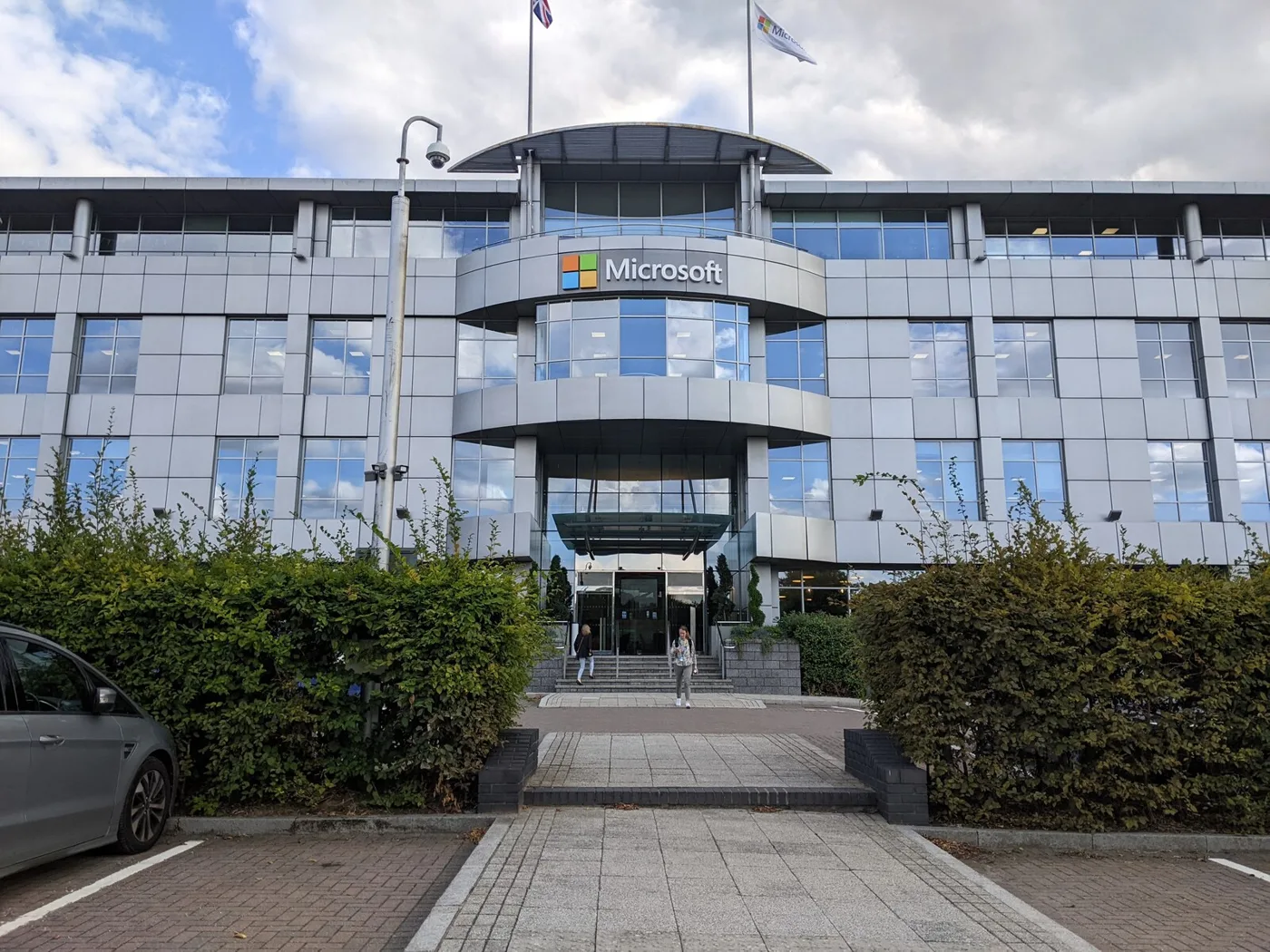

Sonning Parish Council and the ward councillor want the 72MW Thames Valley Park data centre refused. Wokingham officers have not yet decided.
Sonning Parish Council has formally recommended refusal of the 72-megawatt data centre planned for Thames Valley Park, on the eastern edge of Reading. The borough councillor for the ward has done the same, and asked for the application to go to a planning committee if officers back it.
The campus sits in Wokingham borough, about two miles east of Reading town centre, so Wokingham Borough Council decides the outline application, reference 262274. Public consultation closed on 29 October. On 12 November the council’s page still showed no decision, and the decision level was still listed as “Delegated”, meaning officers would decide it.
We reported the details of the scheme when it was submitted: Microsoft’s offices would be demolished and the data centre would run mainly on gas fuel cells until a big enough grid connection arrives, which the applicant expects in 2037.
The parish council’s objection
Sonning Parish Council’s response, dated 29 October, says it does not object to redeveloping Thames Valley Park. Its objection is to “a development of this scale, energy requirement and environmental impact” at this location, beside the River Thames and the Thames Valley Park Nature Reserve, a Local Wildlife Site.
Its main grounds are:
- Carbon. It quotes the applicant’s own environmental statement: about 109,667 tonnes of carbon dioxide equivalent during construction, then about 154,315 tonnes a year in operation.
- Gas. It says a grid connection after 2037 “is not guaranteed”, so gas use “could continue for many decades”.
- Wildlife. It says a single great crested newt survey in a dry April may not have been enough, and that it could find no consultation with Natural England, although the site is in a SSSI impact risk zone.
- Noise. It asks for continuous low-frequency noise to be assessed for homes in Earley and Sonning and for users of the Thames Path.
- Height. The data centre would reach 30.5 metres, against about 16.5 to 20.5 metres for the existing buildings.
The parish compared the yearly operating figure with Wokingham borough’s whole carbon footprint, about 481,020 tonnes in the council’s September 2026 Climate and Nature Strategy. That makes the data centre equal to about 32% of the borough’s reported emissions. The parish council accepts the two figures are not measured on the same basis.
It also says the scheme’s benefits do not outweigh the harm, pointing out that operational jobs are estimated at up to 65 posts. If Wokingham approves the scheme anyway, it asks for a legally binding Section 106 agreement covering promised community benefits such as reusing waste heat, and a construction traffic plan agreed now. The applicant’s programme puts demolition between April and October 2027 and the main works from February 2028 to August 2031.
The ward councillor asks for a committee
Councillor Leon Cook, who represents Thames ward on Wokingham Borough Council, sent a ten-page objection dated 28 October. He wrote: “If officers nevertheless recommend approval, I request referral to the Planning Committee through the applicable procedure.”
His letter says the scheme’s lower-carbon outcome depends on 110MW of grid capacity, of which only 60MW is described as secured. He also tests it against the government’s Data Centre Covenant, published by the Treasury the same day, which he says is national policy guidance rather than part of the local plan.
How much opposition
The parish council’s response counted 107 individual respondents on the planning portal, of whom only two supported the scheme. It also quotes the applicant’s own consultation report: 88% against, 7% for and 5% with no opinion, from 455 residents.
Wokingham’s document viewer now holds 214 files marked as planning comments, up from 33 when we first reported on 6 October. Some people have commented more than once, so that is not a count of people.
Other groups have objected too:
- the Wokingham Energy Collective, a community energy group, which says it was neutral in July but now objects. Of the seven things it asked for in July, it says one has been largely addressed, three partly, and three not at all.
- the Sonning and Sonning Eye Society, which has commented twice, most recently on 11 November
The Energy Collective did welcome two things: closed-loop cooling, and the choice of fuel cells over gas turbines.
When we checked the document list on 12 November, no response had yet been published from Wokingham’s own specialist consultees, such as environmental health or ecology officers, or from the Environment Agency or Natural England.
What it means for you
The consultation has closed, but Wokingham’s officers have not yet decided. If you live in east Reading, Earley, Woodley or Sonning, these are the points to watch:
- Whether it goes to committee. If it does, the meeting would be public and objectors can usually ask to speak.
- The specialist responses. Look for environmental health on noise and air quality, the ecology officer on the nature reserve, and Natural England.
- Further information from the applicant. The parish council and the councillor have both asked for more evidence before any decision.
Late comments are often still read until a decision is made, though the council does not have to take them into account. All the documents are on Wokingham’s document viewer.
Have your say