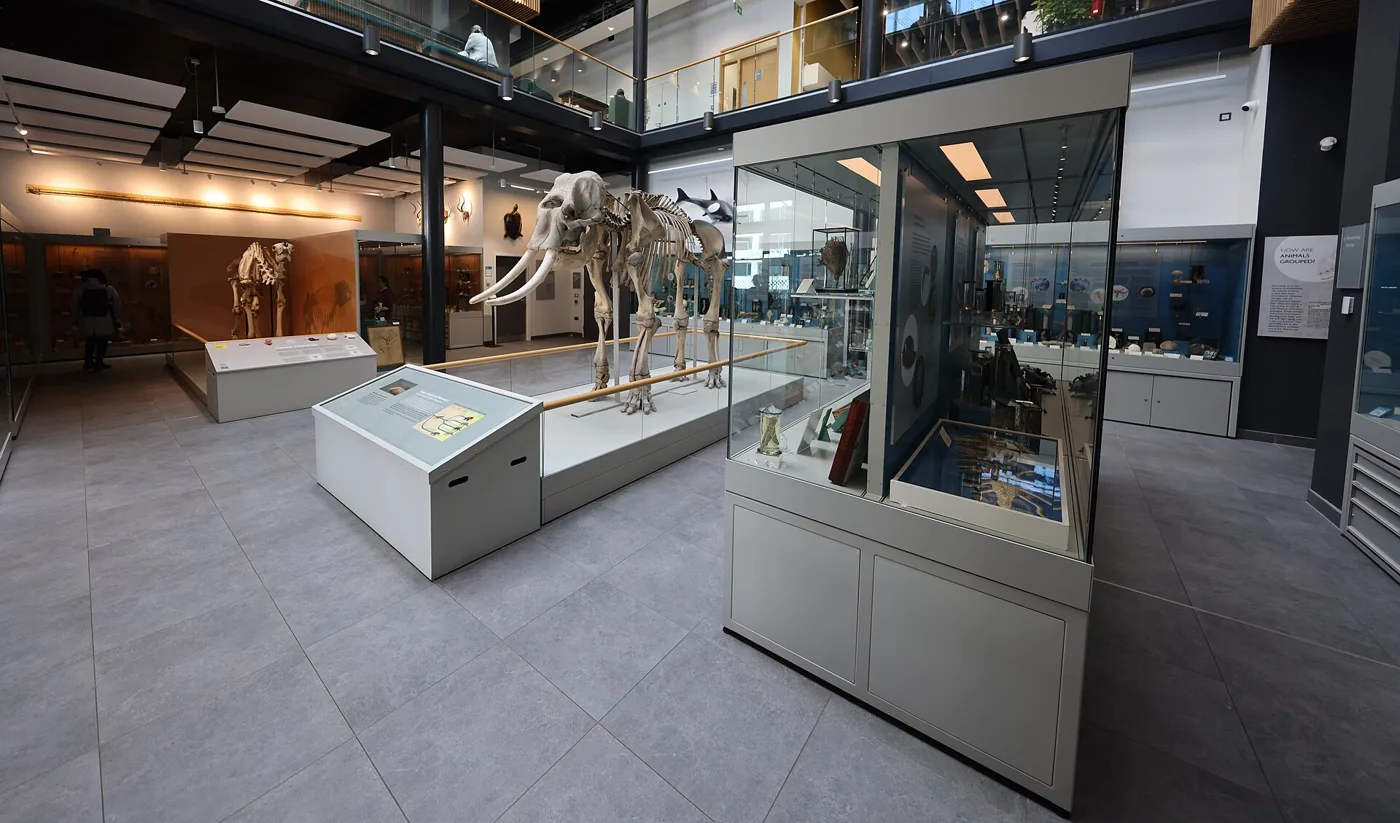

The piano-playing circus elephant whose skeleton anchors the University of Reading's Cole Museum was 175 on Tuesday. Free entry, weekdays 9am to 4.30pm.
Norman, the Victorian circus elephant whose skeleton stands at the centre of the University of Reading’s zoology museum, has turned 175.
Staff and students from the university’s School of Biological Sciences marked the birthday at the Cole Museum of Zoology on Tuesday 22 September. The university announced it on Thursday (University of Reading).
Norman was an Asian elephant. He toured the UK with Manders Menagerie in the 1850s and 1860s. Newspapers of the time reported that he could run races, jump hurdles and play the piano.
From the circus ring to Whiteknights
Norman died in 1867, aged 16. The museum says the cause was a viral infection (Cole Museum highlights).
His body changed hands twice before it reached Reading:
- 1867: Liverpool Museum bought the carcass “in the flesh” for £50.
- 1921: Professor Francis Joseph Cole, the museum’s founder, bought the skeleton from Liverpool for £30. The university puts that at roughly £1,900 in today’s money.
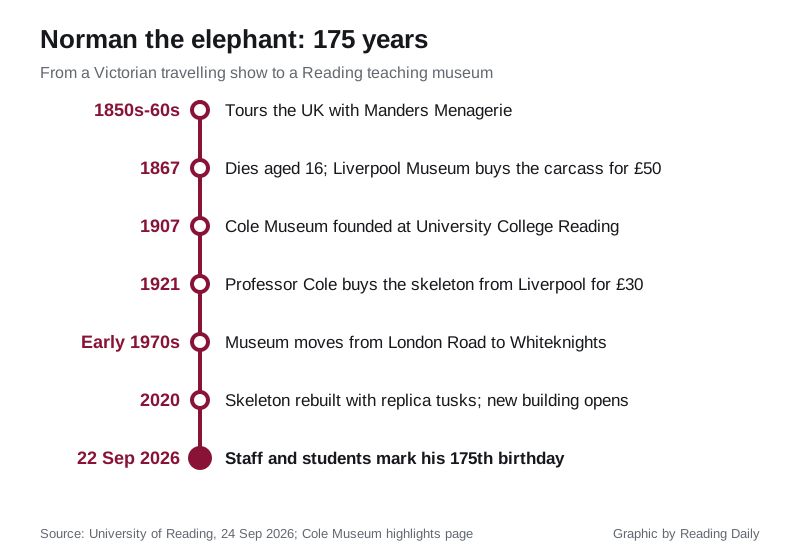
The museum has moved twice. It was founded in 1907 to teach zoology at what was then University College Reading, on the London Road campus. It moved to Whiteknights in the early 1970s.
In 2020 it moved again, into the Health and Life Sciences building. Before that move, a specialist conservator cleaned and rebuilt Norman’s skeleton and made replicas of his tusks.
Professor Amanda Callaghan, the museum’s curator, said: “Norman has had an extraordinary life, and an even more extraordinary afterlife. He entertained crowds up and down the country in the 1800s, and more than 150 years later he is still teaching our zoology students and delighting visitors of all ages.”
She added: “We couldn’t let his 175th birthday pass without a celebration.”
Still a working collection
The museum holds around 38,000 specimens. They include skeletons, taxidermy, fluid-preserved dissections and fossils. Zoology students still study them in practical classes.
In March, Arts Council England renewed the museum’s accreditation for a further five years (University of Reading).
Alongside Norman you can see:
- the skeletons of a camel and a false killer whale
- a platypus and an echidna, gifted by the Australian Government
- cases of preserved animals from around the world
The false killer whale stranded in the Dornoch Firth in 1927 along with 130 others. It is the only specimen hung from the ceiling (Cole Museum highlights).
What it means for you
The Cole Museum is free and open to the public Monday to Friday, 9am to 4.30pm. It is closed at weekends, on bank holidays and on university closure days (Cole Museum: plan your visit).
- Where: Health and Life Sciences building, Whiteknights campus, RG6 6EX.
- Access: step-free, on the ground floor, with an automatic door and an accessible toilet with baby-changing.
- Parking: four accessible bays at P12, right outside. Standard parking is in Car Park 1A at £1.50 an hour or £10 for the day.
- Groups: groups of ten or more must book ahead. School and community groups are welcome.
The museum is on the university’s Whiteknights campus, not the London Road site in town where it started.
If Norman whets the appetite, the university is putting Apollo Moon samples on show on 24 October. It opened its Learning Garden to the public last weekend.
Have your say