
Reading's contactless donation scheme runs to 2029, with £7,400 raised for four homelessness charities. Rough sleeping in the town fell to 43 last autumn.
Reading’s contactless donation scheme for people sleeping rough has been extended to 2029, after raising more than £7,400 in its first year. Reading Borough Council and Reading’s Business Improvement District announced the extension on 11 August.
Tap for Reading lets people donate by card at contactless points around the town, or online. The council says the money is split between four charities commissioned through Reading’s Homelessness Partnership:
- Launchpad Reading
- The Salvation Army
- St Mungo’s
- YMCA Reading
The council estimates the money has directly benefited more than 50 people. It says donations have paid for:
- household items, white goods and basic furnishings for people moving into or holding on to accommodation
- clothing and food
- specialist courses and help getting into work
- travel to appointments
- the identity documents needed to open a bank account or register with a GP or dentist
The extension runs to 2029, subject to annual review. The council says it will look at whether donations can also go to organisations outside the four commissioned charities, and will need to set a selection process for that first.
The scale of the problem it is aimed at
Rough sleeping in Reading fell last year but remains higher than anywhere else in Berkshire. The government’s annual single-night snapshot counted 43 people sleeping rough in Reading in autumn 2025, down from 57 the year before.
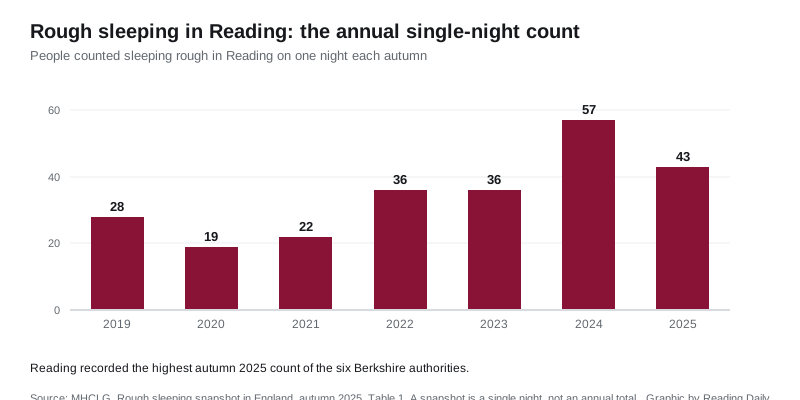
Across the six Berkshire authorities in autumn 2025 the counts were Reading 43, Windsor and Maidenhead 30, Slough 18, West Berkshire 10, Wokingham 7 and Bracknell Forest 5. The 2024 count of 57 was the highest Reading has recorded since the series began in 2010.
The snapshot is a count on a single night, taken by a street count, an estimate or both, so it is a floor rather than a total. Far more people pass through rough sleeping over a year than appear in it.
What the council says about begging
The council presents the scheme partly as an alternative to giving money directly on the street. Its statement says the initiative “complements the Council’s wider work to address aggressive begging and anti-social behaviour in the town centre, including measures introduced under the Public Spaces Protection Order, by offering an alternative to giving direct to people begging who may not be homeless”.
Matt Yeo, lead councillor for housing, said the scheme gives residents a way to give “without worrying about aggressive begging or what that money may be spent on”. He said partner charities had used the donations to help more than 50 people.
The council also says that none of the money donated goes on administration fees or merchant service charges, and that 100% reaches the charity partners.
What it means for you
If you want to donate: the tap points are at locations including The Oracle, Broad Street Mall and Reading station, and there is an online route at reading.gov.uk/tapforreading, which also lists every donation point.
If you are worried about someone sleeping rough: the council points people to StreetLink, which passes an alert to the local outreach team. Give a location as precisely as you can, and a description of when the person is usually there.
If you run a business in the town centre: the scheme is jointly run with Reading’s Business Improvement District, which is the route in if you want a donation point on your premises.
The extension feeds into the council’s Homelessness and Rough Sleeping Strategy for 2026 to 2031, which commits it to closer working with voluntary, community and faith sector organisations.
Sources
- Reading Borough Council, Tap for Reading extended to boost donations supporting people experiencing homelessness, 11 August 2026
- MHCLG, Tables on rough sleeping, rough sleeping snapshot in England, autumn 2025, Table 1
Have your say