

University of Reading scientists found a low-power blue light killed all 64 Campylobacter strains from UK chicken they tested, drug-resistant ones included.
Scientists at the University of Reading have found that a low-power violet-blue light killed every strain of Campylobacter they tested, the bacteria behind most food poisoning from raw chicken. The study is published this week in the journal Microbiology. The university announced it on Tuesday 6 October (University of Reading, 6 October 2026).
The work was done in the university’s School of Biological Sciences with the Animal and Plant Health Agency (APHA). It is still a laboratory result. The team says trials on real chicken carcasses in processing plants are needed before it could be used commercially.
What the study found
The researchers tested the light against 64 Campylobacter samples collected through UK poultry surveillance. These were real strains from the food chain rather than standard laboratory ones. The paper’s summary says they covered three Campylobacter species with a range of antibiotic resistance.
The university’s announcement reports that:
- every one of the 64 strains was killed, whatever its species
- strains already resistant to antibiotics died just as readily as the others
- one strain was exposed to the light 15 times in a row to try to force resistance, and it showed no increase in tolerance
- the method needs no chemicals and does not touch the food
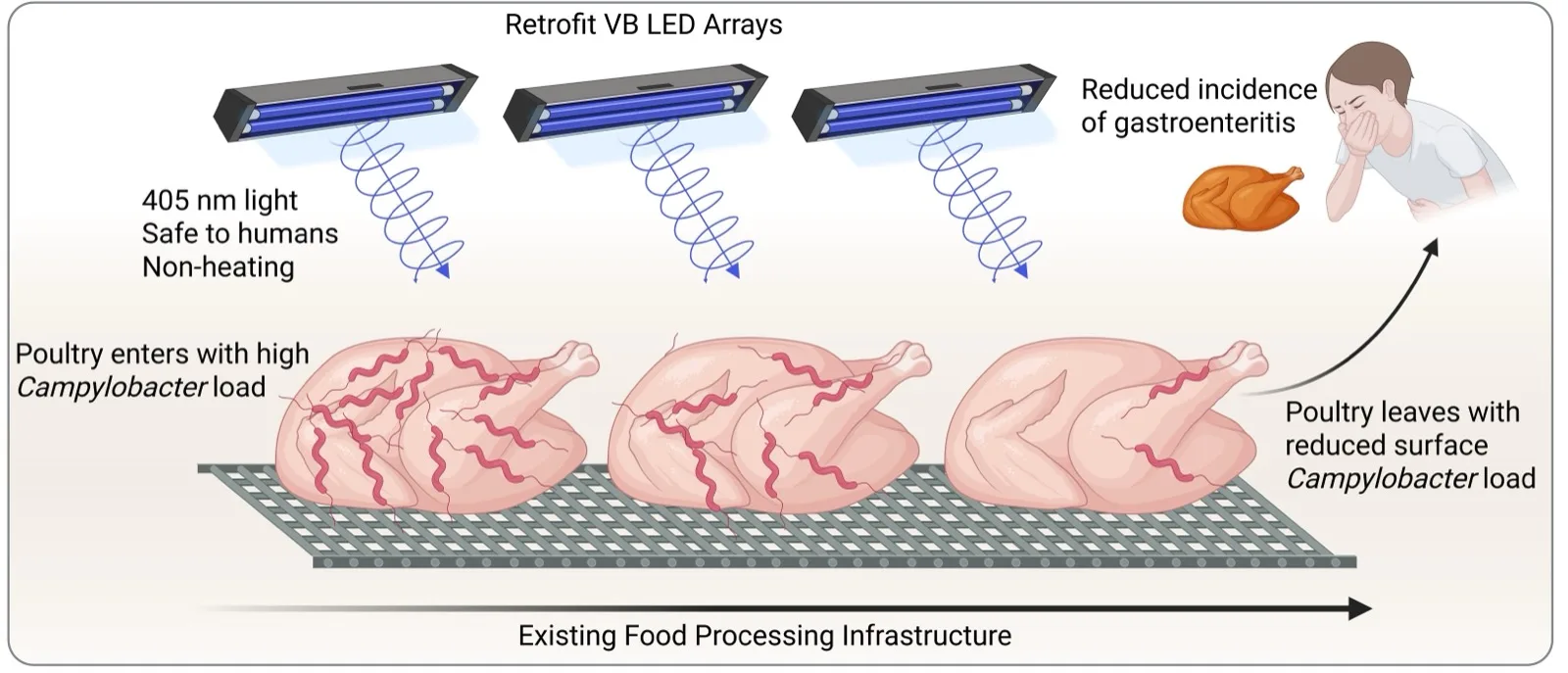
The light is at 405 nanometres, visible violet-blue. It triggers molecules already inside the bacteria to produce reactive oxygen species, which kill the cell from within. The university says the LEDs involved are low-power, long-lasting and cheap to run.
Why it matters
The university says Campylobacter is found on around three quarters of raw chicken sold in the UK. It puts the cost of UK cases at an estimated £700 million a year in healthcare and lost work.
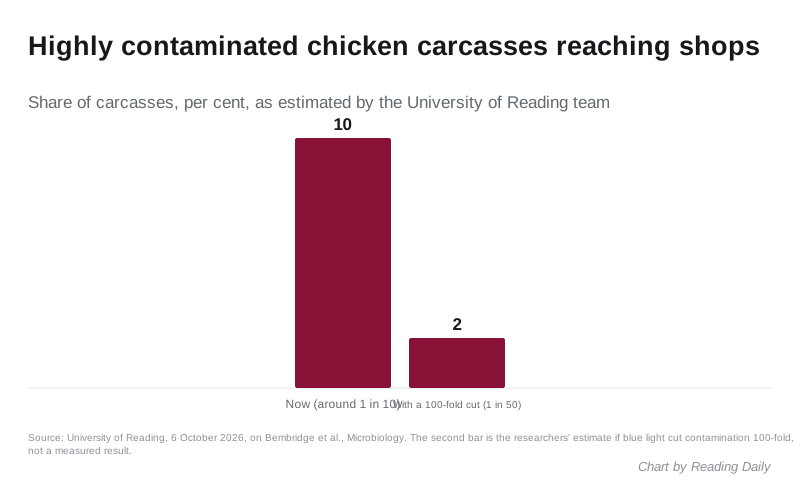
The researchers modelled what a working system might do. If it cut contamination on carcasses 100-fold, they estimate the share of highly contaminated carcasses reaching shops would fall from around 1 in 10 to 1 in 50.
The idea is to fit the lights over the existing lines in processing plants, after slaughter and before the meat is packed.
Earlier work by the same team, published in mSystems, worked out why Campylobacter is so sensitive to this light. The university says that earlier research showed blue light could kill some strains more effectively than the chlorine washes used on chicken in the US.
What the researchers said
Dr Aidan Taylor of the University of Reading is the study’s lead author. He said: “What’s exciting about this light-based approach is that it doesn’t rely on chemicals or antibiotics at all, so it sidesteps the resistance problem entirely.”
He added that the team had shown it “works against a wide range of real-world strains taken directly from UK poultry, including the multi-drug resistant strains that worry us most”.
Dr Samuel Connelly of the APHA co-led the research. He said the results were “highly encouraging” but that “further evaluation using contaminated meat samples is required”.
What it means for you
Nothing changes in the shops yet. This is a lab result, and the chicken you buy this week is handled exactly as before. The Food Standards Agency’s advice on Campylobacter still applies at home:
- never wash raw chicken, because splashes spread the bacteria onto hands, surfaces and clothes
- keep raw chicken in a sealed container at the bottom of the fridge
- use separate boards and knives, and clean surfaces after preparing it
- cook it until it is steaming hot all the way through, with no pink meat and clear juices
The FSA says young children, pregnant women, older people and those with underlying health conditions are most likely to become seriously ill.
The full paper is free to read: Bembridge, Whitmore, Ciesielski, Rodgers, Connelly and Taylor, “One light to rule them all: photodynamic inactivation of diverse Campylobacter”, Microbiology, volume 172.
Have your say