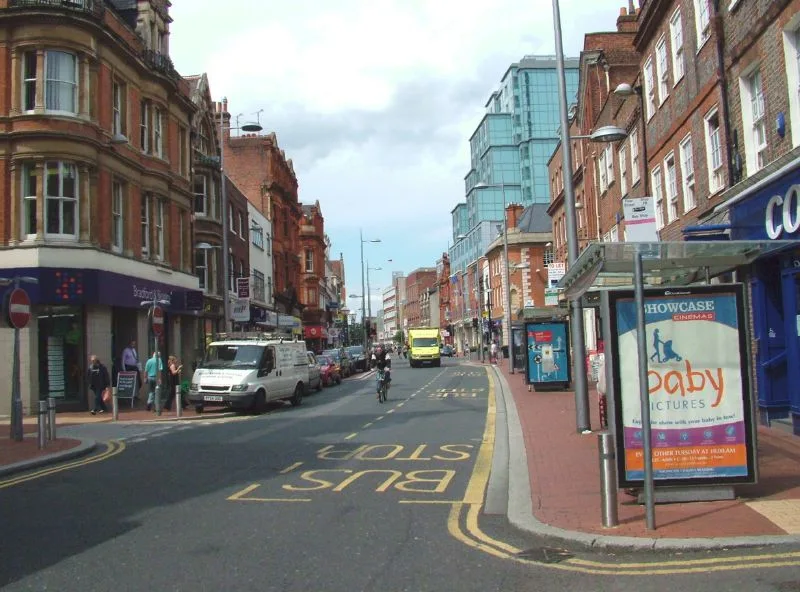

A partly pedestrianised Friar Street, a play park and a new Station Road are the first picks in Reading's 2040 town centre plan. Comments close 30 November.
Reading Borough Council wants to know what people want the town centre to look like by 2040, and its draft plan names four projects to start on first. The best known is Friar Street, where the council would explore partial pedestrianisation, with limited bus access and timed deliveries.
The consultation on the draft Town Centre Vision and Delivery Plan is open until 30 November 2026 on the council’s consultation site. The council announced it on Monday (Reading Borough Council, 19 October).
The reason, the council says, is homes. The number of homes in central Reading is projected to more than double by 2041 under the Local Plan, the fastest growth anywhere in the borough.
The four projects the council would start with
The draft Delivery Plan, as endorsed by councillors for consultation in June, ends with four “recommended priority projects” (draft Delivery Plan, Policy Committee 15 June 2026):
- Friar Street. Turn it into “a safe, vibrant, and walkable civic corridor”. The next step is a feasibility study with traffic modelling. It would explore partial pedestrianisation with limited bus access and timed deliveries, and work with Reading Buses’ parent company, Reading Transport Ltd, on the effect on services.
- Station Road. Reconfigure the main walking route from the station to the town centre to put walking first, while looking at bus movements so the road “remains balanced towards all types of transport”. Phased rerouting is on the list to explore.
- Union Street, “Smelly Alley”. Make it a main pedestrian route in from the station and Friar Street, working with owners and tenants on the mix of shops.
- A town centre play park. A “high-quality, inclusive play space”, on council-owned land or as part of an upcoming development site, designed with families and disability groups.
None of the four has money attached yet. Friar Street would be funded from sources such as a Major Scheme Allocation, council borrowing and pooled developer contributions. The play park would rely on developer contributions, the Community Infrastructure Levy, sponsorship or grants such as Play England’s. Each is marked “pipeline”: a priority with its delivery route still to be decided.
The June report said endorsing the plan “does not commit the Council to specific expenditure beyond agreed budgets”. Business cases would come forward project by project (Policy Committee report, 15 June 2026).
The longer list
The plan also lists projects marked “aspirational”, meaning long-term ambitions that still need funding or feasibility work:
- St Mary’s Butts: reclaim road space for a central civic space, improve the setting of Reading Minster and rearrange the market.
- A pedestrian route from the Oracle to the Thames, through Broad Street and Station Hill, with a river crossing feasibility study.
- Queens Road and London Street junction: reduce the barrier the IDR creates for people walking and cycling.
- Station Square and the Brunel Arcade: a new gateway to the town, with design studies led by Network Rail.
- Green routes, such as Holy Brook Nook and along the Kennet and Thames, with new micro-parks.
- Reading Gaol: the plan says the Ziran Education Foundation intends to turn it into an educational centre, a museum of the gaol’s history, a public exhibition space and, in part, a hotel.
- Arcades for independent shops, naming Union Street, the Bristol and West Arcade and Harris Arcade.
The final phase of Station Hill, led by Lincoln Property Group, is the one partner project marked “planned”.
Who the town centre is for now
The draft Vision includes a profile of the Abbey and Thames wards, which cover central Reading. It shows a population very unlike the rest of the borough (draft Vision, Policy Committee 15 June 2026).
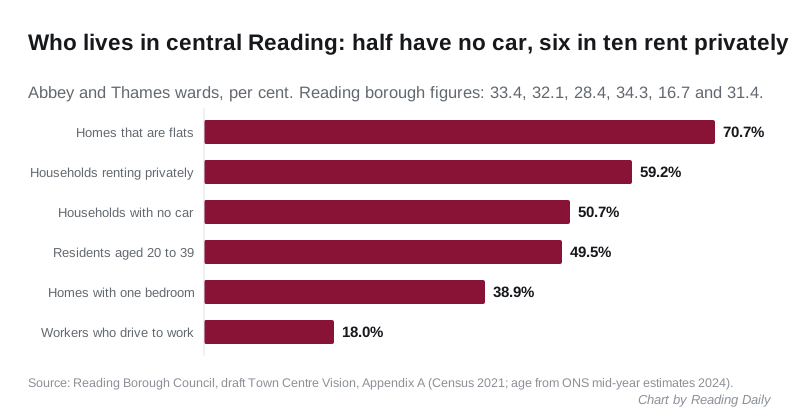
| Measure | Central Reading | Reading borough | England |
|---|---|---|---|
| Population | 20,546 | 182,907 | 58,620,101 |
| Aged 20 to 39 | 49.5% | 34.3% | 26.5% |
| Homes that are flats | 70.7% | 33.4% | 22.2% |
| One-bedroom homes | 38.9% | 16.7% | 11.6% |
| Private renting | 59.2% | 32.1% | 20.6% |
| Households with no car | 50.7% | 28.4% | 23.5% |
| Drive to work | 18.0% | 31.4% | 44.5% |
| Walk to work | 14.4% | 11.4% | 7.6% |
The population figures are ONS mid-year estimates for 2024 and the age split is from the same source. The rest is from the 2021 Census.
The draft draws its own conclusion: families “are present but underserved”, with limited space for children. That is the case it makes for the play park and for more family-sized homes in new schemes.
It also sets out the growth still to come in central Reading. The Local Plan seeks 7,600 new homes, 27,000 square metres of new retail and up to 71,000 square metres of new office space there.
What the council says
The plan rests on seven principles:
- building healthy and connected communities
- transforming Reading’s rivers and public spaces
- enabling connected and active travel
- building a greener, climate-resilient town
- celebrating Reading’s culture, heritage and identity
- reimagining the town centre experience
- supporting growth and innovation
Councillor Liz Terry, the council leader, said the town centre “will need to function as a neighbourhood in its own right”. She said: “In Reading we expect the number of town centre homes to more than double by 2041, which fundamentally alters how we need to look at our centre and plan for the future.”
The Vision is not planning policy and does not replace the Local Plan. But councillors agreed in June that it could be used now, on an interim basis, to inform decisions and investment in the town centre.
What it means for you
You can respond until 30 November. The survey is on reading.govocal.com, with both draft documents. It asks for your priorities, such as better public spaces, walking and cycling, family-friendly facilities or more cultural events, and has space for your own comments.
If you rely on buses along Friar Street, this is the moment to say so. The draft only commits to studying partial pedestrianisation, with traffic modelling and talks with Reading Buses, but the consultation will shape whether that study goes ahead.
The council is also taking the plan to groups, including the Business Improvement Districts, REDA, the Access and Disabilities Working Group and the Older People’s Working Group.
The June report expected the final Vision to go back to committee in December 2026. Consultation started later than the July date it planned, so that may move.
For what is already being built, see our reports on Station Hill’s 600 flats and the Hexagon’s new Studio Theatre walkway. Live works on town centre roads are on our Reading roadworks page, and parking on parking in Reading.
Have your say