

A new law ends Reading's committee system: from May 2027 a Leader and a cabinet of two to nine councillors will take most decisions. What changes for residents.
Reading Borough Council has to give up the committee system it has used since 2013 and move to a Leader and Cabinet by next summer, because a new law requires it. The council plans to make the switch at its annual meeting on 26 May 2027.
The change is set out in a report to full council on 13 October. It follows the English Devolution and Community Empowerment Act 2026, which came into force on 29 June. The Act requires every council in England that runs a committee system to move to executive arrangements.
Councils not involved in a local government reorganisation have a year to make the change. For Reading, the legal deadline is 29 June 2027.
Why Reading cannot keep its system
Parliament agreed some exemptions. A council that adopted a committee system within the last five years by its own resolution, or within ten years after a local referendum, can keep it.
Neither applies to Reading. The report says its move to a committee system “was brought about by a Council resolution passed in 2013”.
What changes
Today, decisions on most council services are taken by cross-party committees of councillors, such as the Policy Committee, which met on Monday (Policy Committee, 19 October). Under the new model:
- Full council elects an Executive Leader.
- The Leader appoints a cabinet of between two and nine councillors, one of them as deputy leader.
- The cabinet takes most decisions, collectively or through individual cabinet members, within the budget and policy framework set by full council.
The report lists the services where decisions “can only be legally made by the Executive” under the new system:
- adults’ and children’s social care
- housing and homelessness
- waste collection and environmental services
- highways and transport
- leisure, libraries and community services
Some decisions stay with cross-party committees, because the law says a cabinet cannot take them. These include planning and licensing decisions, audit, standards and the Health and Wellbeing Board. Full council still sets the budget.
Scrutiny and the forward plan
Two things are new for Reading:
- A scrutiny function. The council must set up at least one overview and scrutiny committee, able to review and challenge cabinet decisions, along with statutory scrutiny of crime and disorder, health and flooding. It must also appoint a statutory scrutiny officer, which the report says “may have financial implications”.
- A forward plan. The cabinet must publish the “key decisions” it intends to take at least 28 clear days in advance. A key decision is one likely to mean significant spending or savings, above a threshold the council sets, or one with a significant effect on two or more wards.
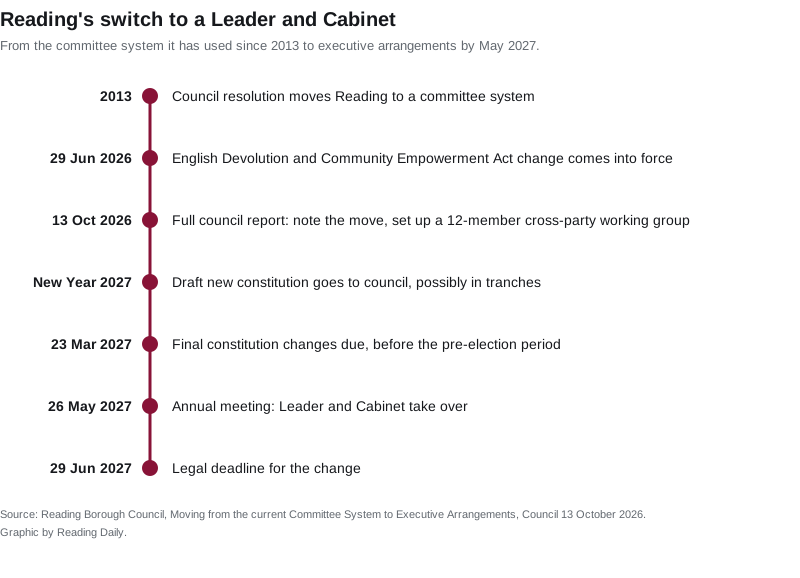
The timetable
Councillors were asked on 13 October to note the requirement and to appoint a cross-party working group of 12 councillors, split 7:3:1:1 between the political groups. The minutes of that meeting are not yet published.
The group will oversee a full review of the council’s constitution, adding new rules for the cabinet and for scrutiny. The plan is:
- New Year 2027: the draft constitution goes to council for approval, possibly in several tranches.
- 23 March 2027: the final changes are agreed, before the pre-election period for the May local elections.
- 26 May 2027: the annual meeting of council, when the new arrangements start.
The work this year is being paid for from existing budgets, the report says. Members and officers will be trained on the new system.
What it means for you
You will not be asked. The report says the change is required by law and “there is no legal requirement for public consultation”. The council says it will draw up a communications plan to explain the changes before they happen.
Decisions will be easier to see coming. The forward plan means big decisions, on things like bin collections, road schemes or care services, must be listed four weeks before they are taken. That gives residents and councillors time to raise objections.
Fewer councillors will take most decisions. At most nine councillors will sit in the cabinet. The rest of the council’s 48 members hold it to account through scrutiny and full council.
Planning and licensing will not change hands. Applications like the Winter Wonderland at Hills Meadow will still go to cross-party committees.
For how the council spends its money, see our Reading council tax bands page.
Have your say