

Reading's draft policy would charge £330 a term for post-16 SEND travel, or £175 for low-income households, where it is free now. Comments close on 5 October.
Reading Borough Council wants to start charging families for post-16 travel assistance, and its draft policy puts the figure at £330 a term.
The council announced the consultation on Monday without naming a price. The draft policy attached to the consultation does name one. The charge would apply to every student who receives travel assistance, and the students who receive it are almost entirely young people with special educational needs or disabilities.
Comments close at 11.45pm on Monday 5 October.
What the draft says it would cost
The council’s draft Post-16 Transport Policy for 2027/28 sets out two rates:
- £330 per term for all students who receive transport assistance
- £175 per term where the student qualifies on low income
Low income means the student was eligible for free school meals at the point of application, or lives in a household on Universal Credit whose earned income is under the free school meals threshold.
The rate applies “whether they attend mainstream or specialist post-16 provision, independent schools, Further Education colleges, or other suitable training establishments”, the draft says. It also applies to families who take the money as a cash budget rather than a bus pass or a taxi.
The policy does not say how many terms are charged in a year. On a standard three-term year, £330 a term comes to £990.
Why that matters more than it looks
The standard offer for 16 to 19 year olds under the draft is not a council minibus. It is a Personal Transport Budget, a payment made to the family to arrange travel themselves. The amount depends on the straight-line distance from home to the school or college.
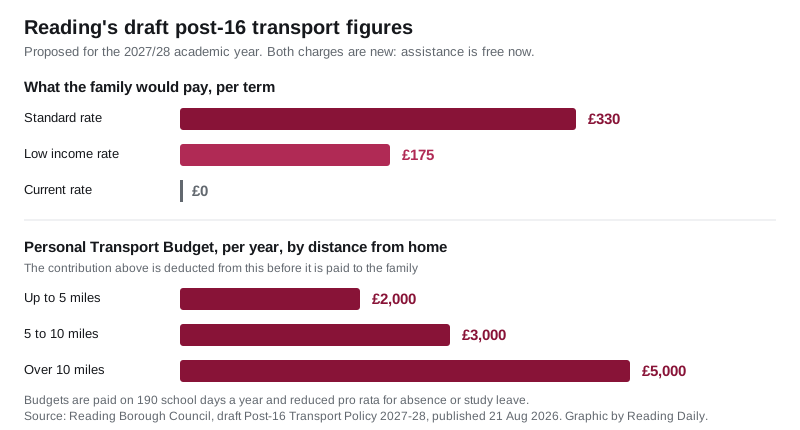
The draft is explicit that the contribution comes out of that budget before the family sees it: “the Council will calculate the value of the budget and apply any contribution required under this policy before payment is made”. For a family in the shortest distance band, £990 over a year would take close to half of a £2,000 budget.
The budgets are also paid on the basis of 190 school days a year, pro rata if the student attends fewer, and are not paid for days the student is not required to attend, including study leave.
Who would be affected
Post-16 travel assistance in Reading is not the same duty as school transport for under-16s. Councils have no legal obligation to provide it, and the council says its current offer goes beyond the statutory minimum.
Under the draft, a student aged 16 to 19 may qualify if all of the following apply:
- they live in the borough
- they have an Education, Health and Care Plan naming a school, or an EOTAS package
- the named setting is the nearest suitable one, not a parental preference
- the course is full time, meaning at least 540 guided learning hours a year
and at least one of the following applies:
- they cannot use public transport because of their special educational needs, disability or mobility difficulty
- they live more than three miles’ walking distance from the setting
- they cannot walk the distance because of a mobility difficulty
Assistance stops at the end of the academic year in which the student turns 19. Students with an EHCP who start a course at 19 or older are covered by separate arrangements running to 25.
The council’s own equality assessment
The equality impact assessment published alongside the draft is blunter than the press release. It was written by Carly Price, the council’s Strategic Lead for SEND, in May 2026, and approved by Director of Education Brian Grady on 1 May.
It records that the council “currently offers fully paid travel support, mileage allowance or council organised transport (COT) which includes solo taxis in some cases”, and that “rising demand and financial pressures have prompted a review”.
On who carries the change, it says: “All pupils on transport will have Special Educational needs and/or Disabilities.” On age, it says 16 to 19 year olds “will have the introduction of charges which have not been the case previously”. On socio-economic disadvantage, it says some families “may find this a difficult additional financial pressure”.
The assessment answers yes to the question of whether the policy could lead to direct or indirect discrimination, noting that it affects people with a disability, and adds that the council does not have a legal responsibility to provide free transport and that other authorities already charge. It accepts there “still remains the potential it will cause distress”.
The mitigations it lists are travel training, discussing travel at the annual review, the reduced low-income rate, case-by-case assessment, and pointing families at the 16 to 19 Bursary Fund. That fund is run by colleges and schools rather than the council. The vulnerable student bursary is worth up to £1,200 depending on circumstances, and the discretionary bursary has no set amount.
The assessment concedes something about the bursary that is worth reading twice: although it has always been available, “we have not previously requested this be used to mitigate transportation costs for learners”.
The other eight changes
Charging is one of nine changes the council lists. The rest, in the council’s own words on the consultation page:
- removing references to Brighter Futures for Children and “the Company”, following the return of children’s services to direct council management
- greater emphasis on independent travel and the support available to build it
- increased focus on Independent Travel Training
- wider use of Personal Transport Budgets as an alternative form of assistance
- rewording and clarification of eligibility criteria and transport assessments after feedback from families
- greater clarity on the range of travel assistance options
- further clarification of arrangements for learners aged 16 to 19 and young adults aged 19 to 25
- updates to contact details, application processes, governance and wording
What it means for you
This is not about September. The document being consulted on is the statement for the 2027/28 academic year. Councils must publish a post-16 transport statement every year by 31 May, so the charge, if adopted, would land on families more than a year from now. Nothing changes for the term starting next week.
If your child has an EHCP and gets travel assistance, this is the consultation to answer. It is the one that decides whether a bill arrives in 2027. The response form is on the council’s consultation platform, and both the draft policy and the equality assessment are attached to it as PDFs. Reading also says face-to-face events are planned, with details to follow.
If your child is approaching Year 11, the eligibility list above is the one to check against, particularly the “nearest suitable setting” test, which rules out a placement chosen on preference.
The deadline is Monday 5 October. The council reviews the statement annually, and says it will alter the policy if there is evidence of unfair or unlawful impact, but that review comes after the charge, not before it.
Separately, Reading Buses is cutting two dedicated school routes and changing nine timetables from Tuesday 1 September.
Have your say