

Reading now cares for 277 children, but its approved foster placements fell from 120 in 2023 to 70 this year. The council's new strategy says it needs more local carers.
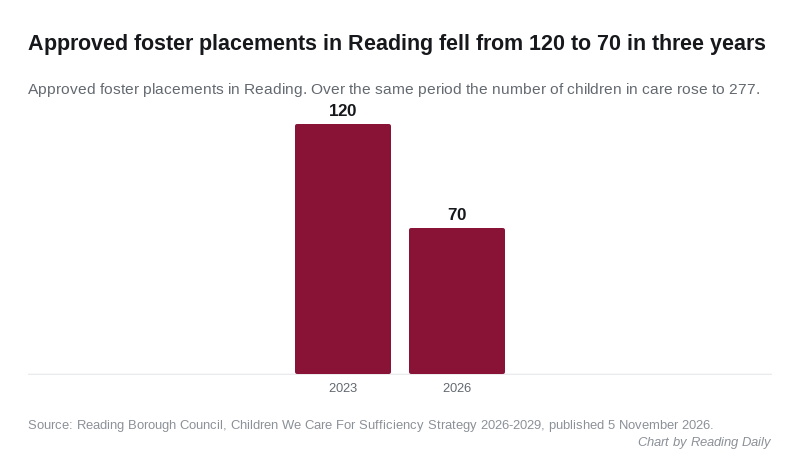
The number of approved foster placements in Reading has fallen from 120 in 2023 to 70 this year. Over the same period the number of children in the council’s care kept rising. It reached 277 in March 2026.
The figures are in the council’s new Children We Care For Sufficiency Strategy, published on 5 November. It sets out how Reading plans to find homes for children in care until 2029. The strategy calls the fall in foster places “a substantial reduction in local fostering capacity”.
What the strategy shows
- 277 children in care in March 2026, up 43, or 18%, from a low of 234 in 2022. That is more than the 271 of March 2021.
- 70 approved foster placements in 2026, down from 120 in 2023.
- 94 placements with independent fostering agencies in March 2026, against 43 with the council’s own foster carers.
- 62% of children in care live with foster families, down from 65% in 2021. The strategy says that is lower than in England, the South East and similar councils.
- 16% live in children’s homes or secure settings, up from 7% in 2021. Reading is now above all its comparator areas. The strategy says the rise is almost all children’s homes, and Reading has no children in secure care.
The children in Reading’s care are also getting older. The 10 to 15 and 16-plus age groups are the largest and are forecast to keep growing to 2029, while the numbers of younger children stay flat. The strategy says this means Reading “needs more adolescent focused foster and residential capacity”.
Why it matters: distance and cost
When there is no local foster home, children are more likely to be placed outside Reading, sometimes more than 20 miles away. The strategy says Reading has seen “an increasing reliance on placements outside the borough”, at a higher rate than many comparable councils. It says distance can affect “family relationships, educational continuity and placement stability”.
The young people consulted for the strategy said the same. Feeling settled was “closely linked to security, continuity and being closer to home”, and many described moving several times.
It is also expensive. A sample of 10 to 12 high-cost placements in June 2026 cost between £9,000 and £23,500 a week, with a median of about £13,600. A group of five or six young people with the most complex needs accounts for an estimated £3.5 million to £4.5 million a year.
The strategy says that on occasion, “only as a last resort”, a lack of homes means unregistered provision may be used. When that happens, it says, senior managers oversee it and the aim is to move the child into an Ofsted-registered home as quickly as possible.
What the council plans
The strategy runs to 2029. Its priorities include:
- recruiting and keeping more foster carers, with more support and training, and retainer arrangements
- developing specialist and therapeutic fostering for teenagers and children with complex needs
- more kinship care, where relatives or friends look after a child; Reading has around 21 kinship carers and 31 places
- more local children’s homes, and fewer distant and high-cost placements
- earlier help for families, to keep children out of care where it is safe
The strategy lists three new council children’s homes, all due to open in summer 2026. Cherry House has two beds, Oak House four and Lime House four. Even with them, it says, Reading has about 15 local residential beds and will still rely on some places outside the borough. A block contract with a local provider secures five more beds.
Cllr Wendy Griffith, lead councillor for children’s services, said the strategy was about “investing in local provision, supporting foster carers and strengthening early intervention services” (council release).
What it means for you
- If you have thought about fostering: Reading is looking for people with a spare room who live within 20 miles of the town. Brighter Futures for Children, which handles fostering for Reading, recruits alongside 19 other councils through Local Authority Fostering South East. You can call 0300 131 2797, email info@lafosteringse.org.uk or start at readingfostering.co.uk (Brighter Futures for Children).
- If you already look after a relative’s child: the strategy names kinship care as a priority. Ask the council’s children’s services about the support available to kinship carers.
- If you pay council tax: the strategy says placements outside Reading are more likely to be bought in from outside providers at higher cost. Its stated aim is a placement system that is “financially sustainable”, by finding more homes in Reading.
Have your say