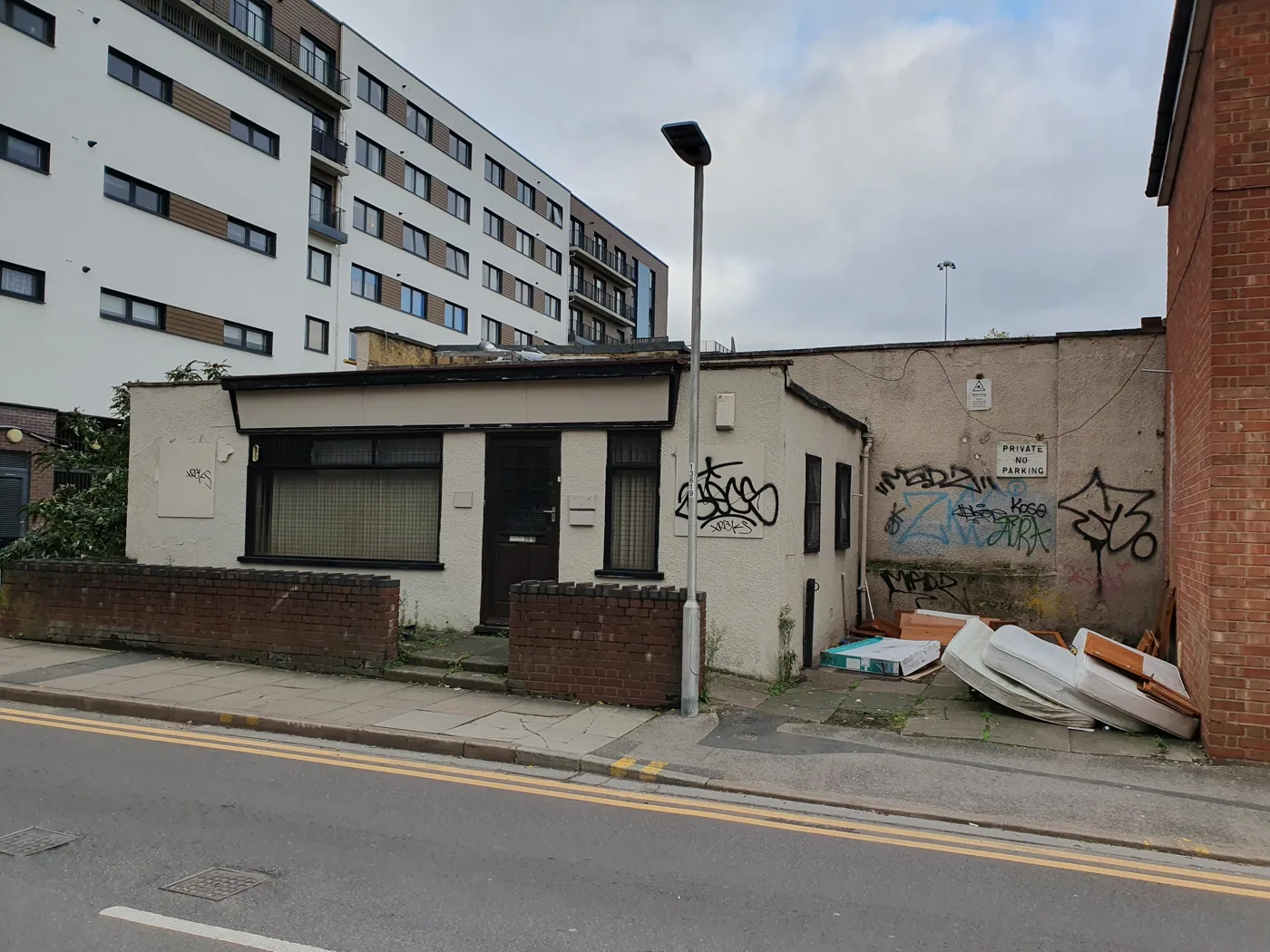

Reading council dealt with 5,685 fly-tipping reports in the year to October and issued 349 fines. Defra's official count rose 71% in 2024/25.
Reading Borough Council dealt with 5,685 reports of fly-tipping in the 12 months to October 2026, and issued 349 fixed penalty notices.
The figures were given at full council on 13 October. Deputy Mayor Amjad Tarar (Labour, Battle) asked what the council is doing about fly-tipping and how many fines it had issued. Councillor Finn McGoldrick, lead councillor for environmental services, replied in writing. The question and reply are published with the meeting papers.
“Make no mistake those who chose to fly tip in Reading will be caught and fined or prosecuted,” the reply says.
The official count jumped in 2024/25
Every council in England reports its fly-tipping incidents to Defra each year. Reading’s return for 2024/25, published in Defra’s fly-tipping statistics in February, shows:
- 2,229 incidents, up from 1,304 the year before
- a rise of 925, or 71%
- the highest count since 2017/18, when there were 2,509
- still below the 2016/17 peak of 3,066
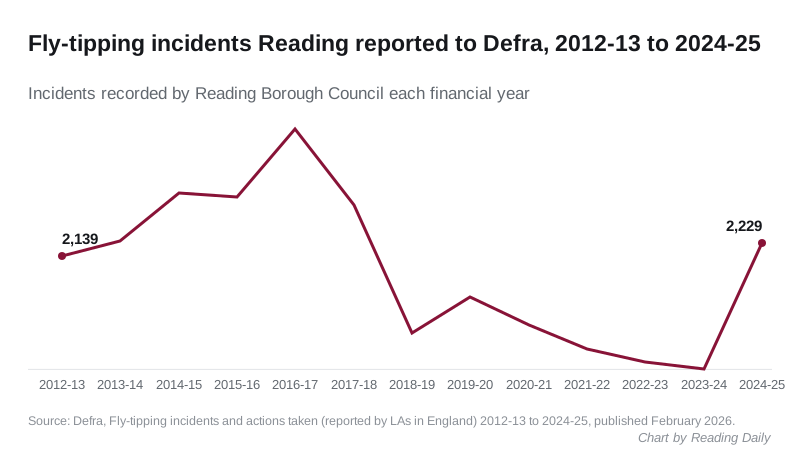
The council’s 5,685 is a different measure. It counts reports the council investigated over a different 12 months, and one dumped pile can be reported more than once. The two numbers cannot be compared directly. Both, though, point to more fly-tipping being reported than a few years ago.
Where it was dumped, and what
Most of the rise in Defra’s figures came from footpaths and bridleways. Incidents recorded there went from 60 in 2023/24 to 697 in 2024/25. Defra’s table does not say why, and part of the change may be in how incidents were classified.
Where Reading’s 2,229 incidents were found:
| Location | Incidents |
|---|---|
| Highway | 988 |
| Footpath or bridleway | 697 |
| Council land | 304 |
| Private or residential land | 103 |
| Back alleyway | 78 |
| Commercial or industrial land | 27 |
Household waste made up the bulk of it. The return records 1,167 incidents of “other household waste” and 557 of household black bags. There were also 143 loads of construction or demolition waste, 99 of electrical items other than white goods, 33 of white goods, 16 of tyres and 3 of asbestos.
Most loads were small. The return records 606 single items and 701 loads the size of a car boot or less. There were 544 small van loads and 196 transit van loads.
How Reading compares
Reading recorded 12.2 incidents per 1,000 people in 2024/25. The median for English councils that year was 11.8, so Reading sits close to the middle.
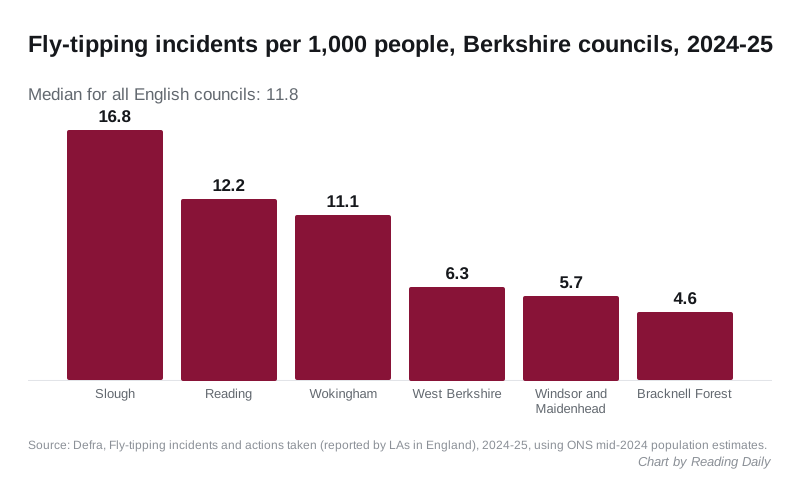
Among the six Berkshire councils, only Slough had a higher rate, at 16.8. Wokingham was close behind Reading at 11.1. Wokingham’s count also rose sharply, from 1,497 to 2,085.
Fines
The 349 fixed penalty notices in the latest 12 months compare with 221 in Reading’s 2024/25 Defra return. Those 221 were made up of:
- 172 for breaching the household duty of care, usually by handing rubbish to someone not licensed to take it
- 8 issued specifically for fly-tipping
- 41 others
The council also recorded 1,004 investigations and 276 duty of care inspections that year. It recorded no vehicles seized.
Who does the enforcement
The council contracts the work to Kingdom Local Authority Support. The reply says Kingdom supplies five environmental enforcement officers:
- four patrol known hotspots across the borough
- a fifth works alongside the council’s mobile cleansing team, looking for evidence in rubbish left at community recycling sites before it is cleared
That contract ends next year. The council is buying a new Environmental Enforcement Partnership to start in March 2027. It will add mobile CCTV, which the reply says will help target hotspots outside the town centre.
What it means for you
Report fly-tipping through the Love Clean Streets app or on reading.gov.uk. A photo, the exact location and anything with a name or address on it all help the council chase it.
In 2024/25 most of Reading’s fines went to householders, not to the person who dumped the waste. If you pay someone to take rubbish away and it ends up dumped, you can be fined. Check any man with a van on the government’s waste carrier register before you hand anything over, and ask for a receipt.
The cheaper route is usually to take it yourself. Our page on Reading tip opening times covers Smallmead and booking.
Have your say