
1,354 Reading homes have stood empty for over a year, and the council has 0.4 of a post to tackle them. Its own target was missed in four of six years.
More than 1,350 homes in Reading have stood empty for over a year, and the council has less than half of one post working to bring them back into use.
The figures come from written answers by Councillor Matt Yeo, Labour’s lead councillor for housing, to two opposition questions at full council on 13 October. Both answers are in the council’s published questions and replies.
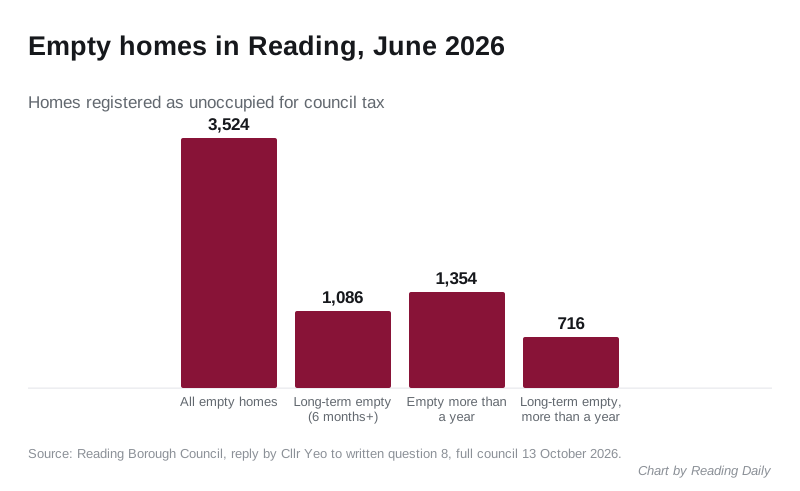
They show that in June 2026:
- 3,524 homes were registered as unoccupied for council tax, across every empty class
- 1,086 of those were long-term empty, meaning unoccupied and unfurnished for six months or more
- 1,354 had been unoccupied for more than a year
- 716 of those were long-term empty homes
0.4 of a post
The council’s Empty Homes Strategy runs from 2020 to 2026. Its work sits in the Private Sector Housing team. According to Cllr Yeo’s reply, the staff time assigned to it has been:
- 0.3 of a full-time post from 2020 to 2023
- 0.5 of a post from 2024 to 2026
- 0.4 of a post now
That works out at roughly two days a week for a borough with more than a thousand long-term empty homes.
The target was met in two years out of six
The strategy set a yearly target for long-term empty homes brought back into use. The reply to Councillor James Moore (Liberal Democrat, Tilehurst) gives the record:
| Year | Target | Brought back into use |
|---|---|---|
| 2020/21 | 20 | 20 |
| 2021/22 | 20 | 19 |
| 2022/23 | 20 | 14 |
| 2023/24 | 30 | 25 |
| 2024/25 | 30 | 29 |
| 2025/26 | 30 | 32 |
“This shows that targets were met in 2 of the 6 years,” the reply says. In total, 139 homes came back into use over six years. The last year was the best, at 32.
Cllr Moore’s question said these figures had only ever gone to private briefings for the lead councillor, never to a committee. He asked for them to be published every year. The reply did not answer that directly. It said a new strategy is being drafted for the Housing, Neighbourhoods and Leisure Committee in March 2027.
The premium money does not go on empty homes
Owners of long-term empty homes in Reading pay a council tax premium on top of the normal bill, and second homes now pay one too. The reply lists the premium charges raised since 1 April 2024 as:
- Empty homes premium: £750,901.98 (2024), £692,006.19 (2025) and £1,320,852.69 (2026)
- Second homes premium: £1,009,589.61 (2025) and £823,636.53 (2026)
That is about £4.6 million in charges raised. The council says it cannot split out how much of it was actually collected. “There is no specific empty homes activity funded from this revenue,” the reply says.
The years are as the council labelled them. Our council tax bands page explains how the ordinary bills are set.
What the council can do
Councillor Rob White, leader of the Green group, asked what happens when owners refuse to act. The reply lists three “secondary” powers in the strategy:
- recovering council debts as a charge on the property, under the Law of Property Act 1925
- compulsory purchase, under the Acquisition of Land Act 1981
- Empty Dwelling Management Orders, under the Housing Act 2004, which let a council take over the running of an empty home while the owner keeps it
“Capacity to use secondary powers is limited by budgets and service resources,” the reply says. It gave no figures for how often any of them has been used.
It added that the government announced reforms to management orders on 27 September 2026. These would cut the time a home must be empty before an order is possible from two years to six months.
What it means for you
If a house near you has been empty for a long time, you can report it to the council’s private sector housing team through reading.gov.uk. Give the address and roughly how long it has been empty.
If you own a home that has been empty and unfurnished for a year or more, you are likely to be paying the empty homes premium on top of your normal bill. The council can advise on getting a property back into use.
The new Empty Homes Strategy is due at committee in March 2027. That is the point at which councillors can set new targets and decide what staff go with them.
Have your say