
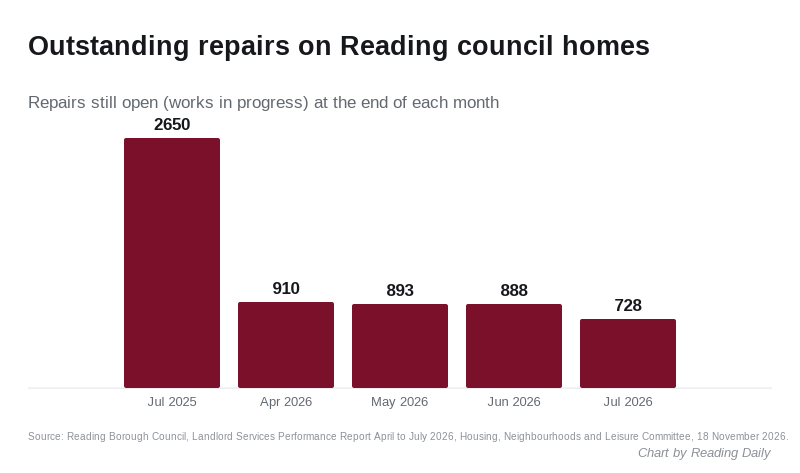
Open repairs on Reading council homes fell from 2,650 to 728 in a year, and 99% of emergency jobs were on time in July. Tenants rate repairs lower than in 2023.
The number of repairs waiting to be done on Reading’s council homes has fallen by almost three quarters in a year. There were 728 open jobs at the end of July 2026, against 2,650 at the end of July 2025.
The figures are in a performance report for the council’s Housing, Neighbourhoods and Leisure Committee, which meets on Wednesday 18 November (agenda). The council set itself a target of fewer than 1,000 by March 2026. The report says it got there in January.
Why the council is reporting this
The service is under watch. The Regulator of Social Housing inspected the council as a landlord and finished in April 2025. It gave a C3 grade against three of its four consumer standards, the report says. The fourth, the tenancy standard, was met.
The council still meets the regulator every month under what the report calls the provider improvement regime. It says the main thing standing between it and full compliance is “underperformance of elements” of the private finance initiative contract run by Affinity Reading Ltd.
Repairs on time
The report compares July this year with July last year:
| Repair type | Target | Jul 2025 | Jul 2026 |
|---|---|---|---|
| Emergency | 3 hours | 51.75% | 98.97% |
| Urgent | 2 working days | 70.83% | 91.23% |
| Routine | 15 working days | 86.53% | 94.66% |
| All repairs | 79.08% | 94.72% |
Satisfaction with individual repairs, asked after each job, rose from 87.86% in June 2025 to 99.85% in June 2026.
The council’s yearly tenant survey tells a different story. In the same report, 66% of tenants said they were satisfied with the repairs service over the last 12 months. That compares with 68% the year before and 80% in 2023. Overall satisfaction with the council as a landlord was 75%, up from 71%. The survey, by NWA Social and Market Research, spoke to 663 tenants between October 2025 and March 2026.
Damp, mould and homes below standard
- Damp and mould: 371 referrals since Awaab’s Law came in, in October 2025. Between April and July, 2 were treated as potential emergency hazards and 11 as potential significant hazards. The report says all were dealt with within the legal timescales. Another 81 were judged outside the law’s scope, and those tenants were given advice.
- Decent Homes: 272 council homes, 4.69%, did not meet the Decent Homes Standard in July. That is down from 329 in April.
- Serious hazards: no severe or urgent health and safety works were outstanding at the end of July.
- Fire safety: every required fire risk assessment and follow-up action had been completed by July.
Complaints
Tenants made 159 first-stage complaints between April and July. Of the 169 the council answered in that time, 47.8% were upheld, against 61% a year earlier. Most upheld complaints were about repairs.
76% of first-stage complaints were answered within the Housing Ombudsman’s deadlines, up from 32% in 2025/26. The report says July slipped because of annual leave, and staff absence is now taken into account when complaints are handed out.
Nine new cases went to the Housing Ombudsman between April and July. One has been decided so far. The ombudsman found failures over repairs and complaint handling, and ordered an apology, £800 compensation and another inspection of the home.
New rules for tenants on 18 November
The same committee is asked to approve five new landlord policies: compensation, estate management, housing fraud, damp and mould, and pest control. The council says they write down how it already works and do not change what tenants are entitled to.
What it means for you
If you rent from the council and have damp or mould, report it with a written description, photos and where in the home it is. The report says those details let the housing energy support team decide faster whether a case falls under Awaab’s Law, which sets fixed deadlines for the landlord to act.
If a complaint is not resolved after the council’s own two stages, you can take it to the Housing Ombudsman.
Have your say