
Reading's claimant count rose by 180 to 5,460 in October. Claimants aged 16 to 24 reached 990, the most since June 2021, and Battle has the highest ward rate.
The number of people claiming unemployment-related benefits in Reading rose by 180 in October, to 5,460. That is 4.3% of residents aged 16 to 64. The figures come from the ONS claimant count, published on Tuesday 17 November.
Overview
- Total: 5,460 claimants in October, up from 5,280 in September and the highest since April.
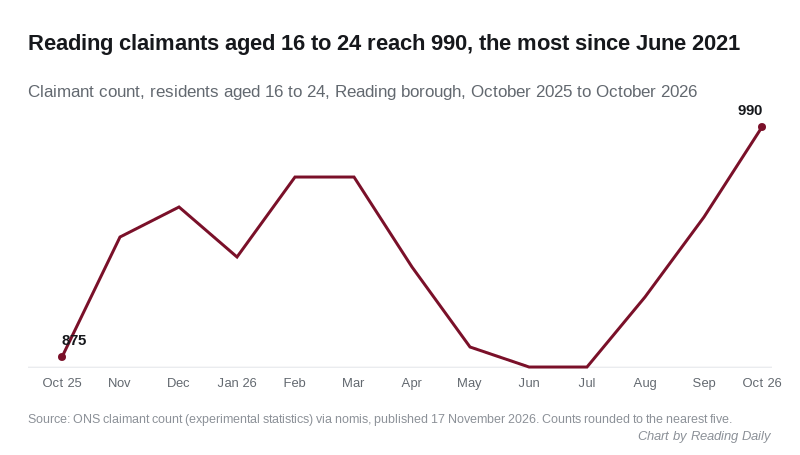
- Young people: 990 claimants aged 16 to 24, up 45 in a month and the most since June 2021.
- Over-50s: 1,250, up 20 on September and down 25 on a year ago.
- Highest ward rate: Battle, at 6.0%. Lowest: Caversham Heights, at 1.6%.
The jump is the largest monthly rise in Reading this year. The total is up 115 on October 2025, when it stood at 5,345.
Young people account for a quarter of the rise
The sharpest change is among 16 to 24-year-olds. There were 875 claimants in that age group in October 2025. There are now 990, an increase of 13%.
The count fell to 870 in June and July this year. It has risen in each of the three months since, from 905 in August to 945 in September and 990 in October. The last time it was higher was June 2021, when it stood at 1,050 as the country came out of lockdown. All figures are from the same nomis dataset.
Ward by ward
Fifteen of Reading’s 16 wards recorded the same or more claimants in October than in September. Only Tilehurst fell, by five to 195. The biggest rises were:
- Park, up 30 to 425
- Southcote, up 25 to 380
- Whitley, up 25 to 410
- Coley, up 20 to 435
The rate is the share of residents aged 16 to 64 who are claiming. It ranges from 6.0% in Battle to 1.6% in Caversham Heights. The ward figures are also from nomis.
| Ward | Claimants | Rate | Change since September |
|---|---|---|---|
| Battle | 535 | 6.0% | up 15 |
| Abbey | 575 | 5.9% | up 10 |
| Church | 430 | 5.4% | up 10 |
| Coley | 435 | 5.3% | up 20 |
| Southcote | 380 | 5.3% | up 25 |
| Norcot | 395 | 5.2% | up 5 |
| Park | 425 | 4.8% | up 30 |
| Whitley | 410 | 4.8% | up 25 |
| Katesgrove | 450 | 4.5% | up 15 |
| Thames | 250 | 4.0% | up 5 |
| Kentwood | 225 | 3.8% | no change |
| Tilehurst | 195 | 3.3% | down 5 |
| Caversham | 215 | 3.0% | up 10 |
| Emmer Green | 140 | 2.5% | no change |
| Redlands | 305 | 2.4% | up 10 |
| Caversham Heights | 90 | 1.6% | up 10 |
Abbey has the most claimants of any ward because it covers much of the town centre. Battle has the highest rate.
How Reading compares
Reading still has the second-highest rate of Berkshire’s six unitary authorities, behind Slough. Every one of the six rose in October.
| Authority | Claimants | Rate |
|---|---|---|
| Slough | 6,560 | 6.0% |
| Reading | 5,460 | 4.3% |
| Bracknell Forest | 2,425 | 2.9% |
| West Berkshire | 2,490 | 2.5% |
| Windsor and Maidenhead | 2,510 | 2.5% |
| Wokingham | 2,340 | 2.0% |
Reading’s rate is above the South East average of 3.2% and the England average of 4.1% for the same month.
What the number measures
The claimant count is not the unemployment rate. It counts people on Jobseeker’s Allowance, plus Universal Credit claimants who are required to look for work. Some of them work part time and have been told to look for more hours. People who are out of work but not claiming are not counted.
Counts are rounded to the nearest five, so the wards add up to 5,455 rather than 5,460. The ONS also revises the latest month when the next one is published, so October’s figure may change slightly in December.
What it means for you
If you are 16 to 24 and out of work: ask your work coach what local training and work placements are open to your age group. Vacancies are listed on Find a job, the government’s free jobs service.
If you are claiming: the group your work coach places you in decides what you must do to keep the payment, and whether you appear in this count.
If you are an employer: the rise in young claimants means more people aged 16 to 24 are actively looking for work in the town than at any point since 2021.
Have your say