

Reading's alcohol death rate is 25.5 per 100,000, nearly double England's. Just 16 opiate users finished treatment last year, the South East's lowest rate.
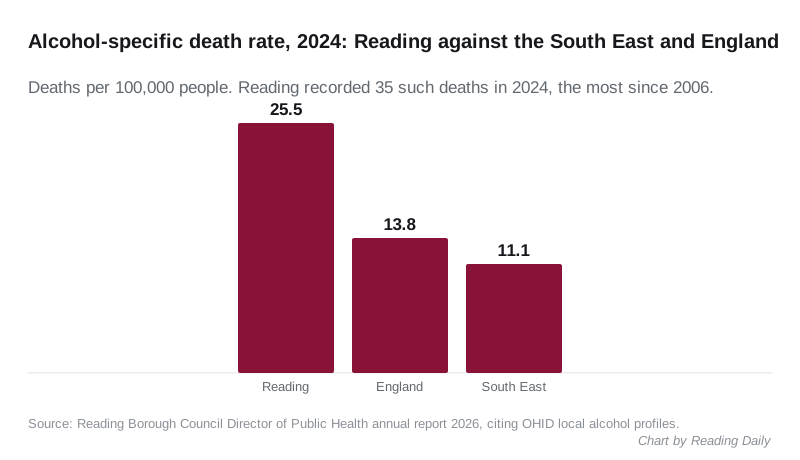
Thirty five people in Reading died from causes wholly due to alcohol in 2024, the most in any year since routine reporting began in 2006. That puts the town’s rate at 25.5 deaths per 100,000 people. England’s is 13.8 and the South East’s is 11.1.
The figures are in the Director of Public Health’s 2026 annual report, published by Reading Borough Council on Thursday. It goes to the council’s Health and Wellbeing Board at 2pm on Thursday 22 October (agenda).
The council’s press release led on recovery stories and called the picture “mixed”. The report itself is blunter on deaths and on how few people finish treatment.
Alcohol: deaths rising while admissions fall
The report uses two measures. Alcohol-specific deaths are those caused only by drink, such as alcoholic liver disease. Alcohol-related deaths add conditions that drink contributes to.
On both, 2024 was a bad year for Reading:
- 35 alcohol-specific deaths, the highest since 2006, when there were 18
- 70 alcohol-related deaths, the highest since 2016, when there were 55
- an alcohol-related death rate of 51.5 per 100,000, against 38.9 in England and 34.6 in the South East
- 27 deaths from chronic liver disease, joint second highest since 2006
Hospital admissions point the other way. Admissions for conditions wholly caused by alcohol were 445.8 per 100,000 in 2023/24. That is the lowest since 2016/17 and well below England’s 611.7.
The report says this means alcohol “continues to cause significant harm and premature death” even though fewer people are being admitted.
It also quotes an Institute of Alcohol Studies estimate that alcohol harm costs Reading about £98.1 million a year, or £567 a resident. Crime and disorder account for £55.9 million of that.
Drugs: few people finish treatment
Deaths from drug poisoning have eased slightly. The rate fell from 10.0 per 100,000 in 2020 to 2022 to 8.5 in 2022 to 2024. That still meant 43 deaths over the three years.
Reading has the highest estimated rate of opiate and crack cocaine use in the South East: 14.4 per 1,000 people aged 15 to 64, or about 1,772 people. It is only the region’s 11th largest council by population.
More people are in treatment than before. The number of adults rose from 995 in 2019/20 to 1,320 in 2024/25. But the report finds results falling behind:
| Adults completing treatment, 2024/25 | Reading | South East | England |
|---|---|---|---|
| Opiates | 2.1% | 6.4% | 5.3% |
| Alcohol | 28.6% | 35.7% | 34.6% |
The 2.1% for opiates is 16 adults. It is the lowest rate Reading has recorded since 2010/11 and the lowest in the South East. For non-opiate drugs the completion rate was 22.6%, down from 54.4% in 2016/17.
The report also estimates that 55.4% of adults who need drug treatment and 68% of those who need alcohol treatment are not getting it.
It puts the poor results down partly to more complex needs. Of adults who started treatment in 2024/25, 69% had a mental health need.
What the report wants done
Dr Matthew Pearce, the council’s Director of Public Health, asks partners to:
- widen access to naloxone, the drug that reverses an opioid overdose
- warn people about nitazenes, very strong synthetic opioids, and about ketamine use among young people
- settle new governance for the treatment system and the Combating Drugs Partnership, which the council is reviewing
- challenge stigma, starting with words such as “junkie”, “alcoholic” or “addict”
“The success of this report will not be measured by how many people read it,” he writes. “It will be measured by whether fewer people die, more people recover, and more families are able to thrive.”
The report features three of Reading’s recovery ambassadors, Ali, Marta and Balazs, who tell their stories in videos released alongside it.
What it means for you
Adults worried about their own or someone else’s drinking or drug use can contact Change, Grow, Live Reading, the town’s adult service. Under-18s can use SOURCE, the young people’s service in the council’s Reconnect youth team.
The report also lists free mutual aid groups, including Alcoholics Anonymous, SMART Recovery and Narcotics Anonymous. Children of parents who drink can get help from NACOA.
Have your say