
Three Reading schemes approved in 2026 add 718 homes but only 73 affordable ones, against 215 under the 30% policy. Council papers show how the cuts happened.
Three housing schemes approved by Reading councillors this year will provide 718 homes, but only 73 of them will be affordable. Had each met the council’s 30% policy, there would be about 215. The figures all come from the council’s own committee papers.
In all three cases the developer argued that the full 30% would make the scheme unviable. The council’s independent advisers accepted a lower figure, and each permission carries a review that could bring in more money later.
A Reading resident who contacted us, and asked not to be named, has put the three schemes side by side and asked whether the policy is working. “This is not an allegation of wrongdoing by developers, councillors or investors,” they wrote. “It is a question of whether the council’s affordable housing policy is achieving its intended purpose and whether the financial safeguards genuinely protect Reading’s long-term interests.”
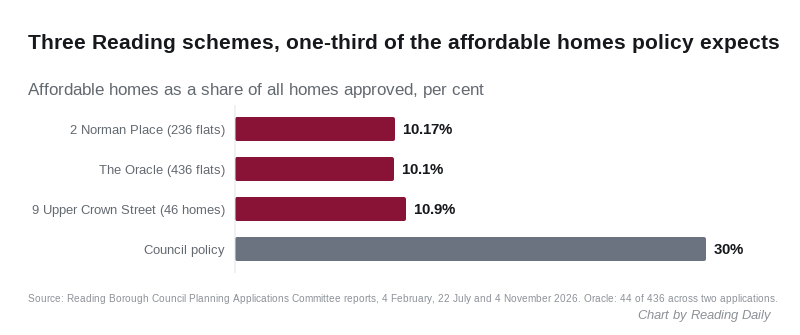
The three schemes
| Scheme | Homes | Affordable | Share | Approved |
|---|---|---|---|---|
| 2 Norman Place, Vastern Road (PL/24/0958) | 236 | 24 | 10.17% | 4 November 2026 |
| The Oracle, former Debenhams and Vue (PL/22/1916 and PL/22/1917) | 436 | 44 | 10.1% | 4 February 2026 |
| 9 Upper Crown Street (PL/25/1338) | 46 | 5 | 10.9% | 22 July 2026 |
| Total | 718 | 73 | 10.2% |
2 Norman Place. The 236 rented flats on the Thames north of the station were approved unanimously on Wednesday. The officers’ report secures 24 flats at Local Housing Allowance rents, in perpetuity. The developer’s adviser, CBRE, said the scheme could afford no affordable homes at all. The council’s adviser, Carter Jonas, did not accept that.
The Oracle. Two build-to-rent blocks of up to 218 flats each will replace the former Debenhams store and the Vue cinema. The December 2025 report sets “not less than 22 units (10% of the total)” in each block, also at Local Housing Allowance rents. Councillors approved both on 4 February.
9 Upper Crown Street. This is the starkest of the three. When the 46 homes were approved in October 2023, the developer, Irongate Property, offered the full 30%: 14 affordable homes. In July this year it asked to change the plans, and its viability appraisal concluded that it could not afford any. The report recommended five, four at affordable rent and one in shared ownership. Officers called the reduction “disappointing, particularly given the critical need for affordable dwellings”, but recommended it, and councillors agreed on 22 July.
The money that might come later
Each scheme has a deferred payment mechanism. This is a second viability test after the homes are built. If values have risen or costs fallen, the extra profit is shared with the council as a payment towards affordable homes elsewhere, up to the value of the full 30%.
For Norman Place the cap is £8,501,690, index linked. For the two Oracle blocks it is £8,870,317 and £8,725,827, agreed at the February meeting.
The resident’s question is about timing. “This review is expected relatively shortly after completion,” they wrote. “Would a sale five, ten or fifteen years later, potentially at a substantially higher valuation, trigger further contributions? Could investors sell the company owning the development without triggering the same financial safeguards?”
The papers answer the first part. At Norman Place the review takes place at whichever comes first: 75% of the flats occupied, or 12 months after they are all finished. At the Oracle it is 80% occupancy or 12 months after completion. Neither report describes a second review on a later sale.
There are other safeguards. Norman Place must stay in single ownership as build-to-rent for at least 20 years, with a clawback of affordable housing contributions if that covenant is broken. At the Oracle, if the flats stop being build-to-rent, the affordable ones must be offered to a housing association and the council, or an equivalent payment made. The reports do not say what happens if the company that owns a block is sold.
What the council’s own review found
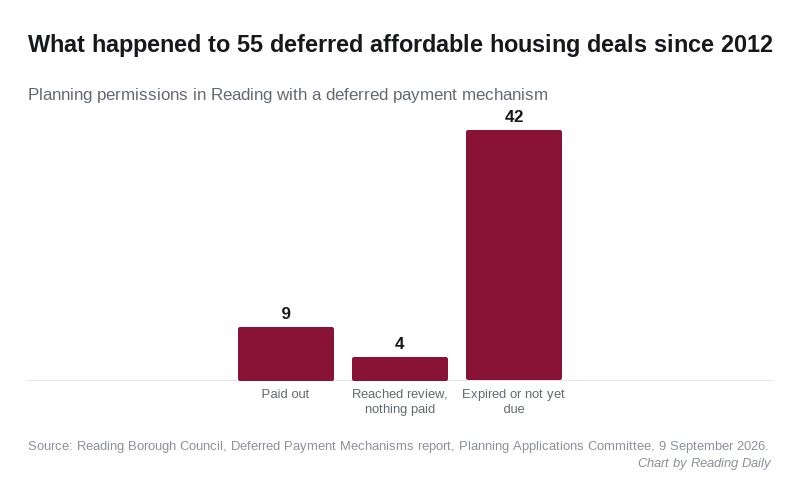
In September, officers gave the planning committee a report on how these deferred payments have worked. It counted 55 planning permissions since 2012 with a deferred payment mechanism.
- Nine had paid out, all but one below the maximum.
- Four had reached their review and produced nothing. Two of those were still being audited.
- The rest had either expired or had not yet reached their review.
Together they had raised £5.5m. Most of that came from two schemes: £3.5m from Kennet Island and £1.6m from Kings Point, now Verto, permitted in 2012 and 2015. Over the same period, the report says, ordinary off-site contributions secured £31m from 346 agreements and delivered £16m.
Officers were frank about the trend. “With a more challenging market, developers are increasingly able to demonstrate that a policy-compliant level of affordable housing is unviable,” the report says, and “increasing importance is being placed on the deferred payment mechanism.” It adds: “It is accepted that agreeing a deferred payment mechanism is a risk as an increase in profit is not guaranteed.”
The resident accepts that many agreements are not yet due. “Nevertheless, these figures raise questions about how effectively deferred contributions compensate for affordable housing that is not delivered initially,” they wrote.
Renting, not buying
Norman Place and the Oracle are both build-to-rent: 672 flats owned by investors and let, none sold. The resident is concerned by that. Norman Place’s management strategy is by Packaged Living, and the resident says the scheme is backed by Packaged Living and Bridges Fund Management.
“Rental accommodation is necessary, but so is the opportunity for people to establish long-term homeownership,” they wrote. “At a time when the Government is introducing further assistance for first-time buyers, should at least some of these developments provide opportunities for residents to purchase their own homes?”
What happens next
Norman Place still needs its legal agreement. The report gives 18 November as the deadline for signing it, which can be extended. Its terms, including the review and the ownership covenant, are settled in that document.
The resident has asked the council for the viability assessments and the Section 106 agreements for all three schemes under the Environmental Information Regulations 2004. The published papers do not answer their questions about later sales or the sale of an owning company.
Council committee papers, including every report quoted here, are on the council’s democracy website.
Have your say