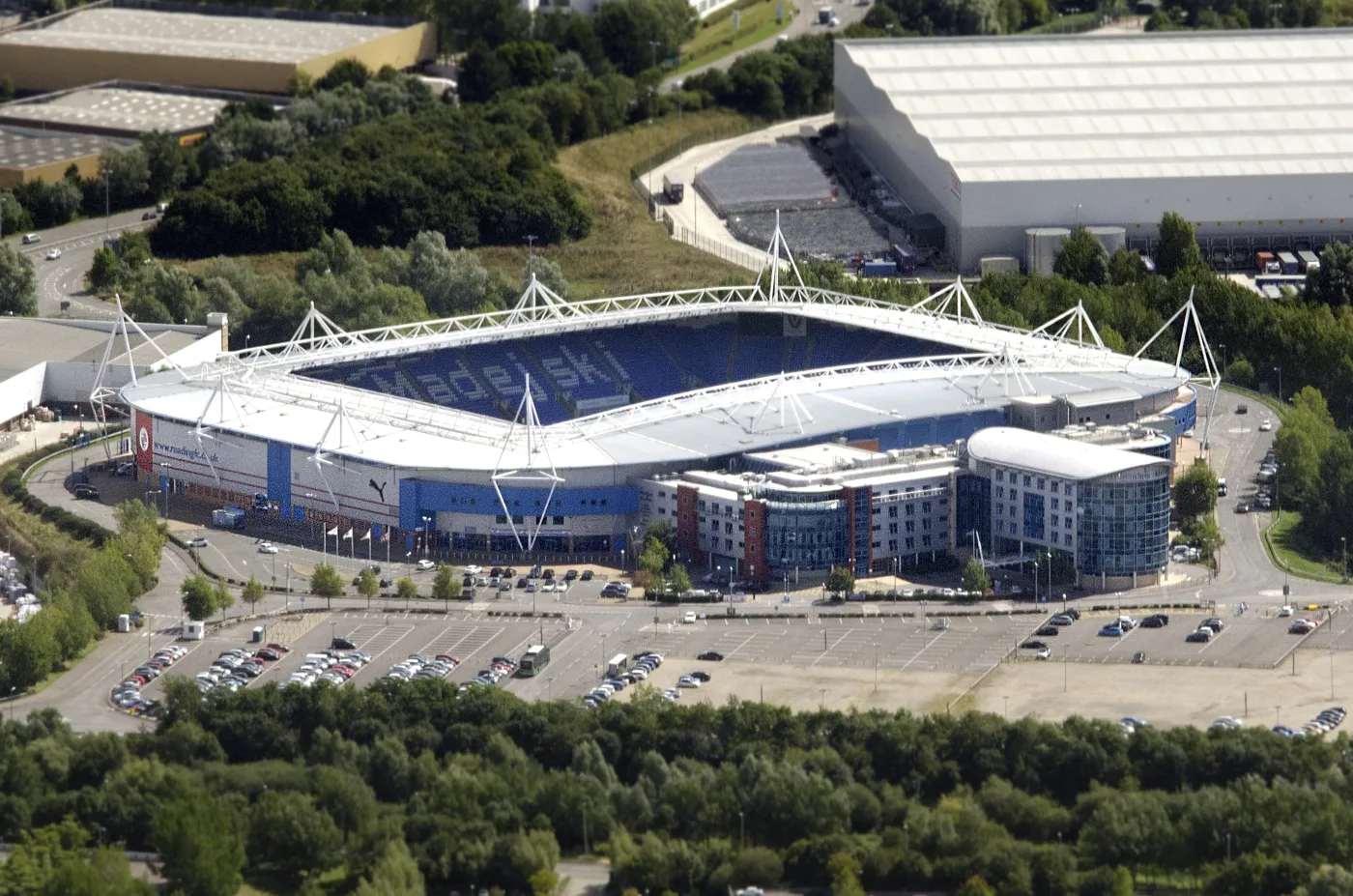

Reading's planning committee voted on 9 September to take the low-risk ground gas target out of the Royal Elm Park agreement. The site is a capped landfill.
Reading’s Planning Applications Committee agreed on 9 September to take a specific ground gas safety target out of the legal agreement governing the land around the football stadium.
The change removes the requirement that the former landfill reach Characteristic Situation 2, the classification the council’s own report calls “low ground gas risk”, before the Royal Elm Park scheme is built. In its place the agreement will require ground gas risks to be “characterised in accordance with the approaches outlined within British Standards and where appropriate, other current, relevant, authoritative guidance”.
The same clauses currently say the work must continue until the waste and gases “are unlikely to be a hazard to human health”. Those five words come out. The replacement is “unlikely to be a hazard to identified critical receptors in the context of the proposed development”.
No public consultation was held on the change, because none is required for a deed of variation.
What the committee actually decided
The application is reference PL/25/0705/DOV, land at Madejski Stadium, Shooters Way, in Whitley ward. The report was written by principal planning officer Alison Amoah and recommended agreement (officer report, Planning Applications Committee, 9 September 2026).
The committee resolved that the Director of Legal and Democratic Services be authorised to agree the deed of variation to Schedule 6, clauses 5 and 6 of section 106 agreement number 4308, as recommended (draft minutes).
The minutes also record something the published report got wrong. A verbal update was given at the meeting “correcting an error in the report, explaining that the applicant was RFC Prop Co Ltd not Reading Borough Council”. The report circulated to the public before the meeting named the council itself as the applicant.
Schedule 6 is titled “Land Contamination and Gas Remediation Obligations”. Clause 6 is the one that keeps the developer paying a Land Management Monitoring Contribution every year on the anniversary of implementation, and it keeps paying until the remedial works satisfy the council. Changing the test changes when that obligation ends.
What is under the car park
The site is the parking area next to the stadium, plus the training dome and outdoor pitches. It is artificially raised ground: a capped landfill that took waste from 1972 to 1985, with fill up to 12 metres deep in parts, still under an environmental permit held by Reading Football Club.
The original 2016 application came with monitoring data, and the officer report is blunt about what it showed. There were “very high concentrations of ground gas in boreholes immediately to the north of the football stadium”, and the ground conditions “may result in major adverse effects on human health”.
The council’s environmental protection manager at the time did not accept the applicant’s case that this was a very low risk gassing site. The report says the data was insufficient to characterise “a landfill site still in the process of decomposition, liable to shrinkage and emission of toxic gases, in particular methane and carbon dioxide”. More boreholes were sunk and more monitoring done.
The consultant’s advice after that round was that the site sat at CS5, high risk, and that the borehole coverage was “the minimum required to provide a general overview of the risk level of the site”.
Why officers say the target should go
The report’s case rests on four points:
- The British Standard does not require a site to be at CS2 before it can be built on. Sites at CS3 and above can be developed so long as design precautions are adopted during construction, and maintained afterwards.
- Requiring a specific classification, proven by 24 rounds of monitoring over two years, is “overly conservative and prescriptive” for this end use, on the council consultant’s more recent advice.
- Monitoring technology has moved on since 2018. Continuous automated gas monitoring means a defensible risk assessment can be done in less than two years.
- The wording change matches conditions 7 and 50 of the original permission, which officers had already amended under a non-material amendment in May 2025 (ref PL/25/0526). The committee decision brings the legal agreement into line with a change that had already been made.
The report also says the new wording widens the test in one respect. “Critical receptors” takes in things the old wording did not, such as groundwater and ecology, not only human health.
The backstop nobody is removing
There is a separate control, and the report leans on it. The land is a permitted landfill site. Under the Environmental Permitting Regulations, the permit has to be surrendered before the site can be redeveloped for housing, and surrender requires the ground gas regime to be classified at CS2 or lower.
That requirement is not in the council’s gift and is not changed by this decision. The report’s conclusion is that development “would not proceed with any significantly increased level of risk to the proposed site end users due to requirements under separate regulatory processes”.
Read plainly, the argument is that the CS2 target is being removed from the planning agreement because the Environment Agency’s permit regime already enforces it. The planning system stops being the thing that checks.
British Standard BS 8485 does set a warning for residential buildings, and the report quotes it. Homes “should not be built on CS4 or higher sites unless the type of construction or site circumstances allow additional levels of protection to be incorporated”, together with a sustainable system for managing and maintaining the gas control system.
What Royal Elm Park is
The permission the agreement belongs to is PL/16/0199, granted on 29 November 2018. It is a hybrid: part detailed, part outline. It covers:
- up to 422 homes in outline, in Blocks 1 to 6, mostly one and two bedroom flats
- 196 homes in Block 7, with 164 parking spaces
- a convention centre and ice rink
- a 246-bedroom hotel and up to 102 serviced apartments
- a multi-storey car park with offices and community space
- a public square and a public park
That is 618 homes in total. Nothing above ground has been built. The permission was implemented through foundation works for the Phase 1 multi-storey car park, and the first reserved matters application, reference PL/25/1655, is with the council now.
The original section 106 agreement dates from 29 November 2018. A first deed of variation followed on 20 October 2023. Because the agreement is more than five years old, section 106A(3) of the Town and Country Planning Act 1990 allows an application to modify an obligation where it “would continue to serve a useful purpose, but in a modified way”. That is the route used here.
What it means for you
Nothing on the ground changes this month. The car park stays a car park, and there is no construction start date attached to this decision.
What has changed is the legal test that has to be met before homes go up on a capped landfill next to the stadium, and who enforces it. From now on the specific low-risk classification sits in the Environment Agency’s permit rather than in the council’s planning agreement.
If you want to follow it, the live document is the reserved matters application PL/25/1655 on the council’s planning register. That is where the first above-ground detail of Royal Elm Park will appear.
There was no public consultation on this change and none was required. The Environment Agency was not consulted on the deed of variation either, although it was consulted on the original application, when it said the assessment of risk to the development from landfill gas “is not within our remit and the local planning authority must make a decision about this”.
Sources
- Officer report PL/25/0705/DOV, land at Madejski Stadium, Planning Applications Committee 9 September 2026 for the proposed wording, the site history, the CS classifications, the consultation position and the officer case.
- Draft minutes, Planning Applications Committee, 9 September 2026 for the resolution and the correction to the named applicant.
- Planning Applications Committee, 9 September 2026, agenda and papers for the full agenda pack.
The minutes for the 9 September meeting are published in draft and have not yet been confirmed by the committee. This report is drawn entirely from the council’s own published documents.
Have your say